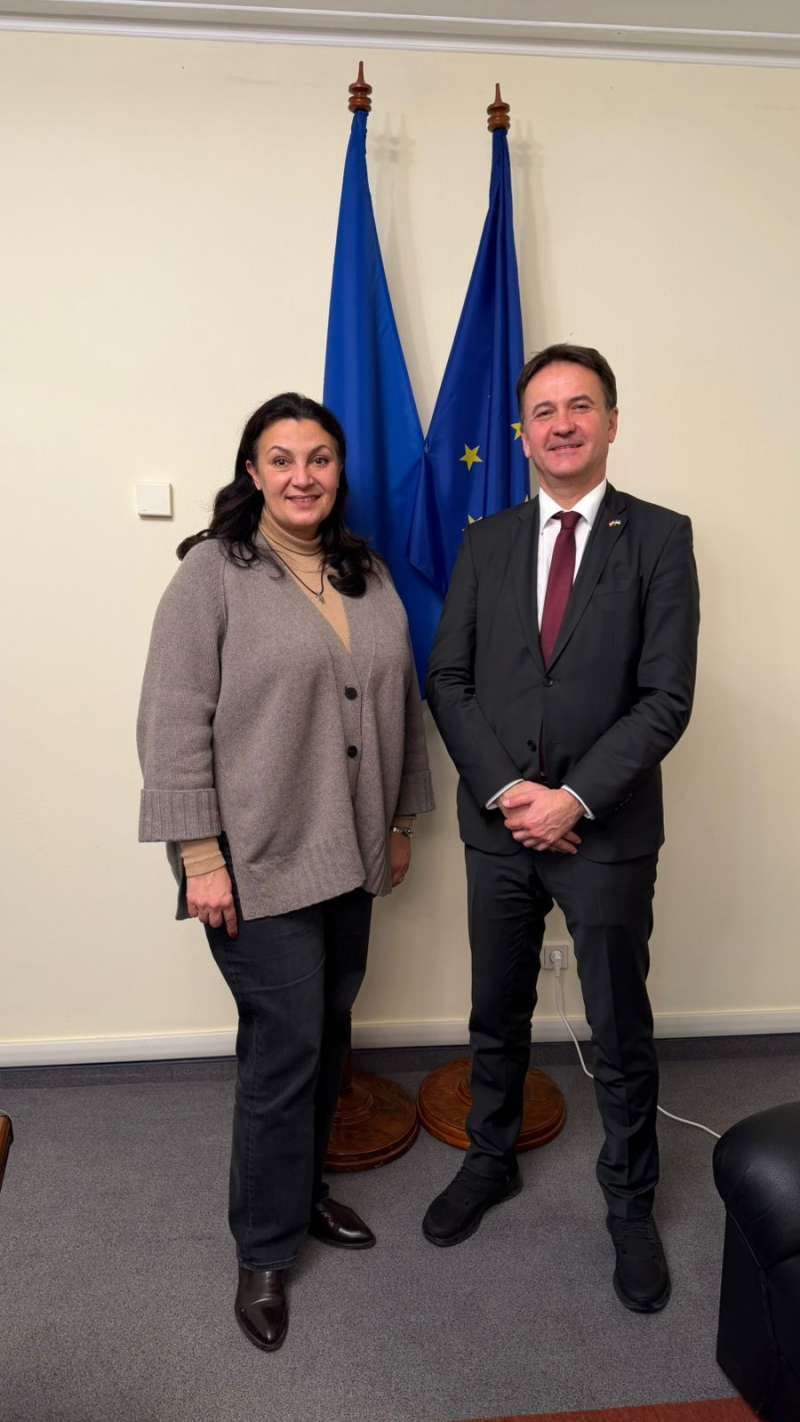
The Chair of the Committee on Ukraine's integration into the EU, Ivanna Klympush-Tsyntsadze, met with the Ambassador Extraordinary and Plenipotentiary of Austria to Ukraine, Robert Müller. The parties discussed the continuation and strengthening of EU support for Ukraine, European integration, the adoption of an EU reparations loan from frozen russian assets, and the domestic political situation in Ukraine.
Ivanna Klympush-Tsyntsadze insisted that Hungary's veto blocking the opening of EU negotiations with Ukraine must be overcome. «Orbán's Hungary is undermining the foundation - the basic values on which the European Union was built. And the longer the EU fails to respond, the more vulnerable it becomes,» said the Committee Chair. She is convinced that the EU should also urgently adopt a decision on a reparations loan for Ukraine from frozen russian assets. The Committee Chair believes that the appearance of negotiations currently being created by russia is in fact a trap for the international community, the aim of which is to achieve a weakening of sanctions and the non-adoption of a decision on reparations: «If the EU delays this decision, it will show the Union's weakness both to russia and to the United States. And that will mean that the EU loses its ability to be a powerful geopolitical player.»
Regarding the so-called negotiations with russia, the Committee Chair is convinced that the russian federation is using its usual tactic of demanding the impossible in order to get something. Ivanna Klympush-Tsyntsadze is confident that Ukraine must act within the framework of the Constitution, and the West must offer Ukraine truly effective security guarantees.
In the context of European integration, they discussed bringing Ukrainian legislation into line with EU law. The Committee Chair noted that some areas will be particularly difficult to adapt and will require a transition period. One such area is the environment. Ivanna Klympush-Tsyntsadze drew Ambassador Robert Müller's attention to the construction of wind turbines on the slopes of the Carpathian Mountains. She reported that this development had caused a great deal of controversy in society, among professionals and among civil society organisations. The Committee on Ukraine's Integration into the EU, together with the Committee on Environmental Policy and Nature Management, even held an off-site meeting to study the situation surrounding the construction of wind farms in the mountainous regions of Zakarpattia, compliance with environmental legislation and Ukraine's international legal obligations in the field of European integration.
The Committee Chair noted that Austria's experience would be very useful in this area. «The situation surrounding this construction project requires additional attention. Therefore, the example of Austria, which has experience in constructing renewable energy facilities in compliance with legislation and with care for the environment, would be very useful in Ukraine," the Committee Chair emphasised. Ivanna Klympush-Tsyntsadze also warned against unjustified expectations regarding the speed of Ukraine's accession to the EU. According to her, Ukraine has a huge amount of work to do in order to bring all areas of life into line with European standards and thus eventually become a strong and competitive member of the European Union.
The meeting also discussed the domestic political situation in Ukraine. Ivanna Klympush-Tsyntsadze stressed that due to attacks on anti-corruption bodies in the summer and corruption scandals in the government this autumn, Ukraine must work hard to restore the trust of its citizens and international partners. ‘It is important for all of us – our civil society and Western partners – to closely monitor the situation in Ukraine. Ukrainian society has come to the defence of anti-corruption institutions, so when looking for arguments to continue supporting Ukraine, we must focus on trust in the Ukrainian people,» said the Committee Chair.