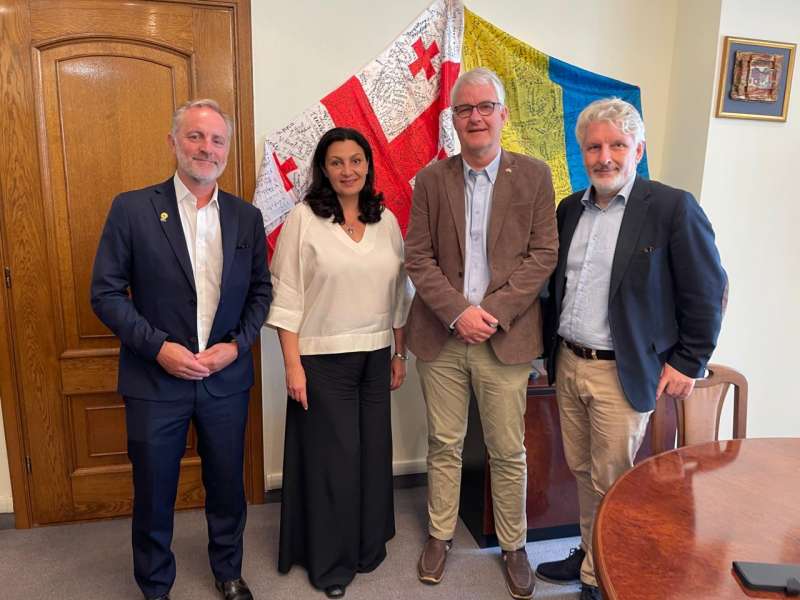
The Chairwoman of the Committee on Ukrainian Integration into the EU, Ivanna Klympush-Tsintsadze, met with Delegation of the Norwegian-Ukrainian Friendship Association. «Norsk-ukrainsk venneforening» is a non-profit, non-partisan, and non-governmental organization that has been working since March 2022 to strengthen Norway’s military and economic support for Ukraine. Its members are professionals from various fields and sectors, all of whom contribute on a voluntary and unpaid basis.
Ivanna Klympush-Tsintsadze expressed her gratitude to the Norwegian activists for their continued and dedicated support of Ukraine: «Thank you for everything you are doing for Ukraine. I truly hope you will not grow weary, as we are at a critical juncture. Much has already been done for Ukraine, yet we are still far from the outcome we all hope to achieve.» According to her, while numerous political declarations and promises are being made and a series of summits are taking place, there is still a lack of urgency in Europe when it comes to supporting Ukraine. Moreover, a shared understanding of the real threat posed by russia is still absent. «We are seeing this, for example, in the ongoing discussions around the adoption of the 18th package of sanctions against russia. Some countries are blocking or attempting to negotiate concessions for themselves. This is disheartening,» she said.
She is convinced that all the discussion about possible truce with russia is not only unfounded, because russia doesn't want peace, only Ukraine's capitulation, but also dangerous. They create a misleading impression that a truce is just around the corner and thus only divert attention from Ukraine's real needs - even more military and political support. These conversations, according to the Chairwoman of the Committee, also demobilise society by creating false expectations when the aggressor is not going to move towards peace.
Ivanna Klympush-Tsintsadze warned that war is, in fact, much closer to European countries than many realize, and that putin is currently testing their unity in supporting Ukraine. Therefore, she stressed, it is critically important to revive a sense of urgency within European societies and to foster a realistic understanding of the situation unfolding in Ukraine. «We need more weapons, more air defense systems, and more investment in Ukraine’s defense sector,» said the Chairwoman of the Committee.
She emphasized that support for Ukraine is, in reality, a mutually beneficial process. By assisting Ukraine, Western partners are effectively investing in their own security, strengthening their defense potential, and enhancing their overall resilience.
According to Ivanna Klympush-Tsintsadze, Norway can also support Ukraine by contributing to the financing of weaponry that Ukraine aims to procure from the United States.
The Chairwoman of the Committee on Ukraine’s Integration into the EU called on Norwegian activists to work with politicians to ensure that russia’s frozen assets are confiscated for the benefit of Ukraine. In her view, legal mechanisms for this can be found, provided there is sufficient political will among European governments. russia, she stressed, must pay for the war in Ukraine, and Europe must recognize that this is its war as well. russia is already waging war against European countries while pretending to be fighting only against Ukraine.
She also warned about the danger of a new narrative that has recently been spreading — the idea that “anything” is better than war. She questioned whether those promoting this notion truly understand what that “anything” would mean for Ukraine, noting that, in reality, it implies the destruction of the Ukrainian people and everything that defines Ukrainian identity.
Ivanna Klympush-Tsintsadze encouraged the delegation of the Norwegian-Ukrainian Friendship Association to promote personal visits by Norwegian politicians to Ukraine. She noted that only direct presence allows for a clear and unbiased understanding of what is really happening. These visits also provide politicians with additional arguments — both for communicating with their societies about supporting Ukraine and for engaging with their colleagues. That is why, she emphasized, personal presence in Ukraine is critically important at this time.