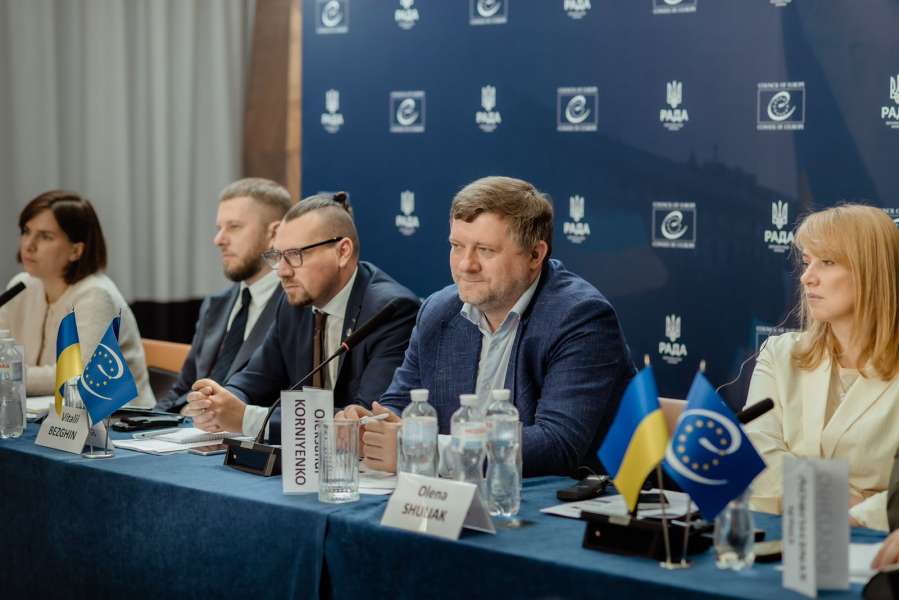
The fourth session of the High-Level Dialogue on Good Democratic Governance took place in Lviv on July 3–4, 2025, to discuss progress made and to reach consensus on further steps toward improving the legislative framework for multilevel governance and elections in Ukraine.
The event brought together key Ukrainian stakeholders and representatives of the Council of Europe. The Ukrainian delegation, led by First Deputy Speaker of the Verkhovna Rada of Ukraine Oleksandr Korniienko, included Members of Parliament from various political parties and parliamentary groups, in particular members of the Parliamentary Committee on State Building, Local Governance, Regional Development, and Urban Planning; senior officials from the Ministry for Communities and Territories Development of Ukraine, including Deputy Minister Oleksii Riabikin; representatives of the Central Election Commission, headed by Chairperson Oleh Didenko; and representatives of Ukraine’s four national associations of local self-government authorities. Among them were Tetiana Yehorova-Lutsenko, President of the Ukrainian Association of District and Regional Councils, and Oleksandr Korinnii, Head of the Association of Amalgamated Territorial Communities, as well as representatives from the Association of Ukrainian Cities and the All-Ukrainian Association of Communities.

Participants recognized Ukraine’s progress in strengthening its system of multilevel governance and focused on key priorities such as:
updating the Concept for Reform of Local Self-Government and Territorial Organization of Power in the context of wartime challenges and the EU integration process; delineating powers across different levels of government; restoring local self-government in de-occupied and frontline territories — including the transition from military to civilian administrations; and
addressing the duration of mandates for local elected officials during martial law.
Participants also acknowledged the coordinated efforts of the Verkhovna Rada of Ukraine, the Government, and the Office of the President in developing and implementing reforms. They emphasized the importance of maximizing the involvement of local authorities, their associations, and civil society in the policy-making and decision-making processes.
Special attention was given to the forthcoming outcomes of the 2025 Ukraine Recovery Conference, scheduled to take place in Rome on July 10–11, where reforms related to multilevel governance are expected to be among the key topics.
The Dialogue also served as a platform for forward-looking and inclusive discussions on the legal and institutional prerequisites for conducting democratic post-war elections in Ukraine. Ukrainian parliamentarians, representatives of the Central Election Commission, civil society, and experts engaged in a constructive dialogue regarding the constitutional and legal foundations of upcoming elections, particularly in the context of the transitional period necessary for their appointment, organization, and conduct following the end of martial law.
Participants discussed possible next steps to improve existing electoral legislation, considering legal mechanisms and practical measures that can ensure the integrity, inclusivity, and security of the electoral process in the post-war period.
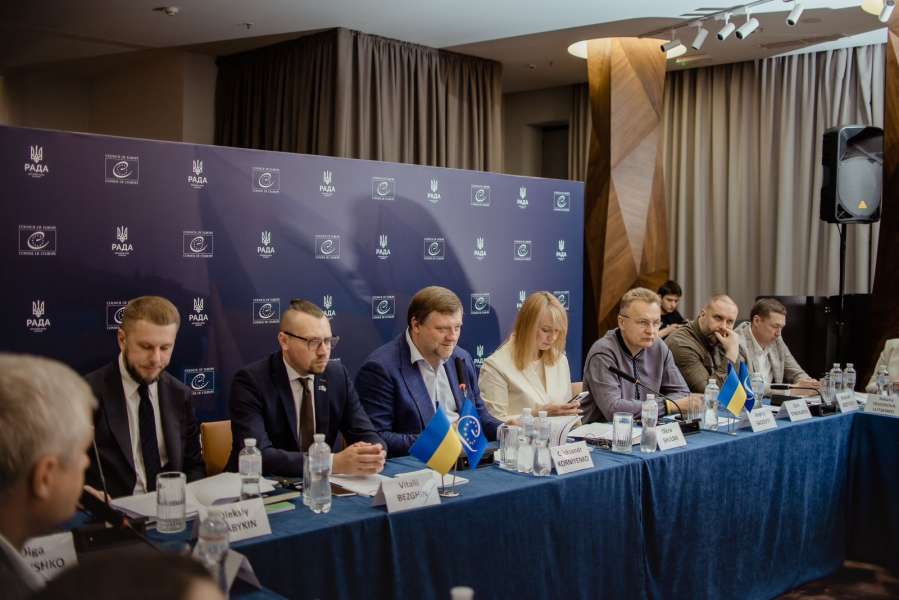
The event was opened by First Deputy Speaker of the Verkhovna Rada of Ukraine Oleksandr Korniienko, Director of the Congress of Local and Regional Authorities of the Council of Europe Claudia Luciani, and Director of Committees of the Parliamentary Assembly of the Council of Europe Louise Barton.
«Accession to the European Union is not only Ukraine’s strategic goal. It is a daily effort to reform our institutions based on democracy, transparency, and accountability. We must lay the foundation for resilient multilevel governance, update electoral legislation, and ensure the continuity of power even in times of war. We highly value the support of the Council of Europe and our partners on this challenging but necessary path,» emphasized Oleksandr Korniienko.

Claudia Luciani emphasized the importance of ensuring a transparent and inclusive consultation process that takes place regularly and within established timelines, in order to maintain a format based on trust among all stakeholders.
The Director also highlighted the complexity of certain issues, particularly the restoration of public authority in temporarily occupied territories, and stressed the need to address these challenges from short-, medium-, and long-term perspectives despite the highly unstable situation.
She welcomed the broad consensus achieved on key strategic directions, including the update of the decentralization concept and efforts to clarify the division of powers among different levels of governance.
«The fundamental principles enshrined in the European Charter of Local Self-Government serve as a reliable guide for Ukrainian authorities in their decision-making process,» she noted.
Louise Barton emphasized that preparing for post-war elections is not only a legal and organizational task but also a democratic opportunity to restore public trust and rethink the social contract between citizens and the state.
She welcomed the proactive steps already taken by the Verkhovna Rada of Ukraine and the Central Election Commission, including the development of legislative initiatives and evaluation criteria for organizing future elections.
Confirming the Parliamentary Assembly’s long-term commitment, she stated:
«The Parliamentary Assembly of the Council of Europe proudly supports Ukraine throughout this process — before, during, and after the elections — because we believe in Ukraine’s democratic future. And we know that the future is shaped precisely in forums like these, through these conversations, and through the dedication you demonstrate every day.»
During the Dialogue, high-ranking Ukrainian officials also expressed their views, including Oleksii Riabikin and Oleh Didenko.
Oleksii Riabikin remarked: «Decentralization has provided a significant impetus for community development. Over 11 years of reform implementation, substantial results have been achieved: a new administrative-territorial structure has been formed, the interbudgetary relations system has been updated, and communities have become more responsible and closer to the people. However, this reform was conceived and implemented under peaceful conditions. Since the full-scale invasion, reality has changed. Our current task is to preserve the achievements while also providing communities with tools for further development and integration into the European governance system.»
Olena Shuliak, Chair of the Verkhovna Rada Committee on State Building, Local Governance, Regional Development, and Urban Planning, emphasized: «We need to continue working on implementing decentralization reform, strengthening community capacity, enhancing civil society’s involvement in local decision-making processes, and improving the realization of citizens’ rights to participate in local self-government — particularly in the context of community reconstruction.»
Vitalii Bezgin, Member of Parliament and Chair of the Subcommittee on Administrative-Territorial Structure and Local Governance, stated: «This Dialogue markedly differed from previous years: alongside the traditionally strategic issues related to the continuation of decentralization, we also delved into current self-governance challenges and even agreed on the next steps to address them — steps that received consensus from all parties involved.»
Tamila Tasheva, Member of Parliament and Chair of the Subcommittee on the Restoration of State Authority and Local Self-Government in Temporarily Occupied Territories of Ukraine, including the Autonomous Republic of Crimea and the City of Sevastopol, noted:
«It is essential to develop a unified, systemic approach to both occupied and de-occupied territories, taking into account their specific conditions, experiences of occupation, and the state of local self-government. Within the framework of the subcommittee I lead, together with the Ministry for Development, other governmental and non-governmental actors, and with the involvement of international partners, we will work on strategic solutions — including the restoration of Ukrainian authority, post-war elections, and responses to demographic and other changes caused by the occupation.»
Alina Zahoruiko, Member of Parliament, Deputy Chair of the Committee, and Chair of the Subcommittee on Elections, Referenda, and Other Forms of Direct Democracy, stated:
«The suspension of elections during the legal regime of martial law is consistent with the Constitution of Ukraine. Accordingly, the key—but not the only—condition for preparing the electoral process for post-war elections is the cessation of martial law. The Dialogue helps all participants find flexible yet legitimate solutions to the issues raised.»
Serhii Vlasenko, Member of Parliament from the All-Ukrainian Union «Batkivshchyna» faction in the Ninth Convocation of the Verkhovna Rada, repeatedly emphasized during the event: «Any changes to electoral legislation must be made strictly in accordance with international standards, foremost the recommendations of the Council of Europe and the OSCE.»
Oleh Didenko emphasized that since 2022, the Central Election Commission, in partnership with the relevant parliamentary Committee, government institutions, and civil society organizations, has been working on updating electoral legislation and implementing practical measures for organizing the electoral process in response to the consequences of russian aggression.
He noted that «special legislation must comprehensively address and regulate the impacts of russian aggression during the organization and conduct of post-war elections, while duly ensuring citizens’ electoral rights. Legislation for post-war elections should also provide authorized bodies with clear procedures and algorithms for coordinated planning, financing of electoral process needs, and responding to security and other risks that may impede free expression of the will.»
At the same time, the preparation of legislative proposals is complemented by practical measures already being implemented on an ongoing basis by the Central Election Commission, including in areas of cybersecurity, updating information-analytical systems, as well as developing communication and training solutions to properly organize post-war elections.

This Dialogue once again confirmed its relevance and constructive nature as a platform for exchanging views, planning future reforms, and fostering joint work between Ukrainian stakeholders and the Council of Europe to improve the legislative framework in accordance with European standards, best practices, and Ukraine’s European Union integration course.
The Dialogue is organized within the framework of the programme «Strengthening Multilevel Governance and Local Democracy to Support Ukraine’s Recovery» and the project «Supporting Democratic Post-War Elections in Ukraine – Phase II,» implemented as part of the Council of Europe Action Plan for Ukraine «Resilience, Recovery, and Reconstruction» for 2023–2026. This Action Plan was developed in response to the aggression of the russian Federation against Ukraine.
The High-Level Dialogue was initiated by the Council of Europe in November 2022 at the request of the Verkhovna Rada of Ukraine, the Government, and the Central Election Commission.