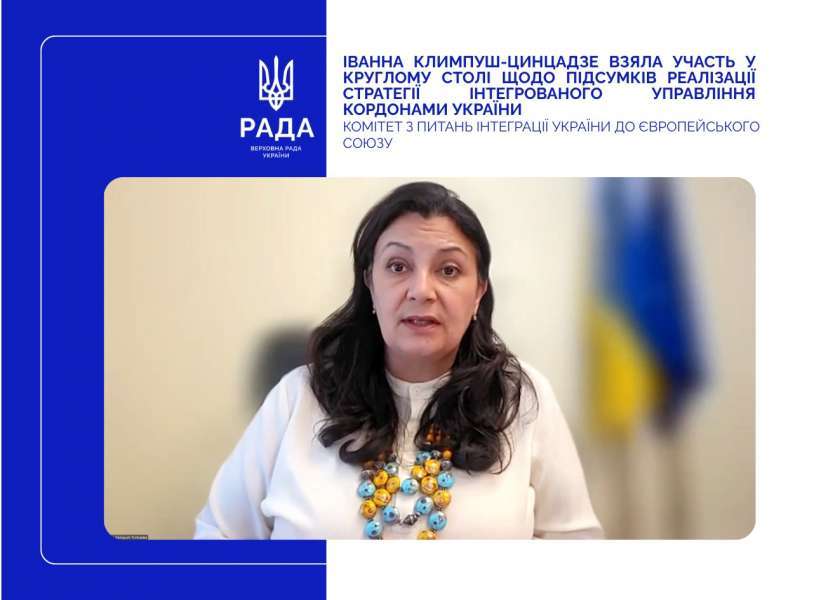
Ivanna Klympush-Tsyntsadze, Committee Chair on Ukraine's Integration into the EU, took part in the roundtable discussion "From Vision to Real Results: 5 Years of Ukraine's Integrated Border Management Strategy."
The event was dedicated to the results of implementation of Ukraine's first Integrated Border Management Strategy, as well as further steps in this area. It was organised by the analytical centre "Europe Without Barriers", with the support of the International Renaissance Foundation and the EU.
Ivanna Klympush-Tsyntsadze emphasised that Ukraine has achieved positive results in implementing Ukraine's first Integrated Border Management Strategy. She thanked the Administration of the State Border Guard Service of Ukraine, which, according to her, was the main driving force of this process. She also expressed her gratitude to the international partners who provided Ukraine with technical and expert assistance.
The Chair of the Committee stressed that the Committee on Ukraine’s Integration into the European Union is closely monitoring the assessment of the results of the first Integrated Border Management Strategy, work on the next steps, as well as the initial outcomes of the new Interagency Working Group on the development of the National Schengen Strategy.
"For the Committee, which I have the honor of chairing, it is important to know how the analysis of the results of our first strategy is progressing, and how work on the next steps is being carried out. We are also monitoring the initial results of the new Interagency Working Group on the development of the National Schengen Strategy," said Ivanna Knympush-Tsyntsadze.
She recalled that, within the framework of parliamentary oversight, the Committee held four field meetings with the support of the EU Advisory Mission and with the involvement of a broad range of stakeholders, including ministries, agencies, civil society organisations, and international partners.
“We can say quite clearly that such engagement and the active attention of the parliamentary Committee to what is happening within the implementation of this strategy have helped to a certain extent to revive processes that were put on hold at the beginning of the full-scale invasion,” said the Committee Chair.
According to her, the work of the Committee also contributed to accelerating the establishment of the Border Management Coordination Centre. “We have significantly accelerated the establishment of the Border Management Coordination Centre. And we can indeed be proud that this institutional capacity has been created on the basis of the Situation Centre of the Ministry of Internal Affairs. It can be said that there are already certain results of this interagency coordination, as well as certain results of more effective information exchange,” she said.
At the same time, the Chair of the Committee noted that in the field of integrated border management there remain many issues that require further work. In particular, a more structured mechanism for responding to crisis situations is needed: “We must honestly acknowledge that there is still room for improvement and work to be done.”
She noted that the need for further improvement in this area is also emphasised by the European Commission in its Enlargement Report. Ivanna Klympush-Tsyntsadze stressed that for effective progress it is important to speak honestly not only about achievements, but also about problems and failures. “It is good to talk about results — we have achievements to be proud of — but we must also speak very honestly about failures in order to draw the right conclusions and take them into account in the future. Otherwise, if we keep deceiving ourselves, we will not reach the goals we have set,” the Committee Chair said.
She also drew attention to challenges in interagency coordination. According to her, despite the overall political coordination and the responsibility of the Deputy Prime Minister for European and Euro-Atlantic Integration, the function of secretary of interagency working groups is assigned to the State Border Guard Service. In her view, this may create a certain “bottleneck” for the effective advancement of this area. “There must be oversight, continuous monitoring, follow-up and ongoing work. In my opinion, this remains a challenge to ensure successful progress,” she noted.
The Chair of the Committee also drew attention to the needs that remained unmet following the suspension of support from USAID. According to her, it is important to raise these issues with partners from the European Union. Ivanna Klympush-Tsyntsadze proposed sending the Committee a list of specific needs in the field of integrated border management, so that Members of Parliament could raise these issues during international meetings with partners.