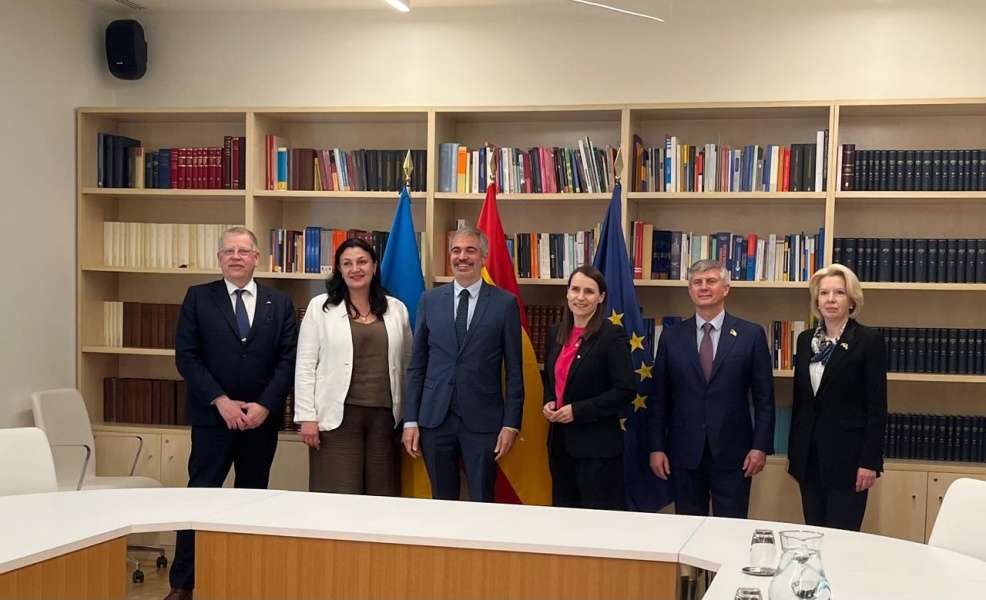
Ivanna Klympush-Tsintsadze and Vadym Halaichuk met, in particular, with representatives of the Security Committee of the Congress of Deputies of Spain, the Foreign Affairs Committee of the Congress, the Foreign Affairs Committee of the Senate, and the European Affairs Committees of both the Congress and the Senate.
They also held meetings with representatives of Spain’s main political forces — the Spanish Socialist Workers’ Party and the People’s Party — as well as representatives of the Office of Prime Minister Pedro Sánchez, the State Secretary for the European Union at the Spanish Ministry of Foreign Affairs, journalists, and experts from think tanks.
Ivanna Klympush-Tsintsadze noted that this year Spain marks the 40th anniversary of its accession to the European Union, and that this experience carries particular significance.
“For Spaniards, for the overwhelming majority of political forces represented in the Spanish Parliament, and for society as a whole, the European Union symbolises victory over autocracy, as well as democracy, prosperity, opportunity, and development. They deeply value their belonging to the European community and are ready to help other countries join it, including by supporting Ukraine’s European integration aspirations,” the Chair of the Committee noted.
Ukraine’s progress towards EU membership, including the need to officially open negotiations on all clusters, was an important topic at every meeting. “There is support from Spain here and a willingness to continue assisting us,” Ivanna Klympush-Tsintsadze stressed.
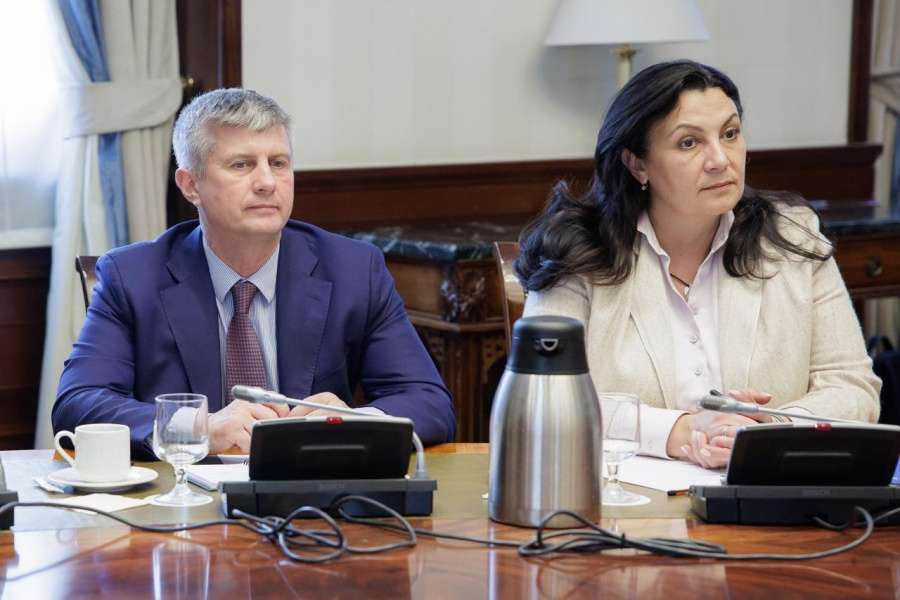
A key focus of the meetings was the discussion of military assistance to Ukraine. Ivanna Klympush-Tsintsadze stressed that since the beginning of russia’s full-scale invasion, Spain has annually allocated around €1 billion in bilateral military assistance to Ukraine. According to her, the Spanish government has announced the same amount for this year.
“We consistently emphasised the need to invest in joint weapons production — both in Ukraine and abroad — as well as in the transfer of critical military capabilities available in Spain, particularly air defence systems needed to protect Ukrainian skies,” the Chair of the Committee stated.
The international delegation also raised the issue of increasing Spain’s participation in the PURL mechanism for the procurement of weapons from the United States that are not available in European countries. Spain has already allocated €100 million to this programme. According to Ivanna Klympush-Tsintsadze, officials in Madrid understand that despite the geographical distance from Ukraine, the threats posed by russia are common to all of Europe.
The meetings also focused on financial support for Ukraine, in particular the need to continue working on the use of frozen russian assets.
“We still need to jointly find a way to use these assets specifically to support Ukraine, and not only through credit mechanisms,” noted Ivanna Klympush-Tsintsadze.
Considerable attention was also devoted to strengthening sanctions pressure on russia, particularly efforts to counter the russian shadow fleet. According to the Chair of the Committee, the activities of such a fleet create not only financial but also security and environmental risks for Europe.
“We discussed the need to more actively combat the russian shadow fleet, since it not only finances russia’s war machine. It also poses environmental risks and may be used as a platform for various acts of sabotage against European Union countries,” Ivanna Klympush-Tsintsadze said.
She added that the international delegation of parliamentarians — friends of Ukraine — saw a clear willingness among Spanish politicians and government officials to work towards increasing pressure on russia and limiting the capabilities of its shadow fleet.
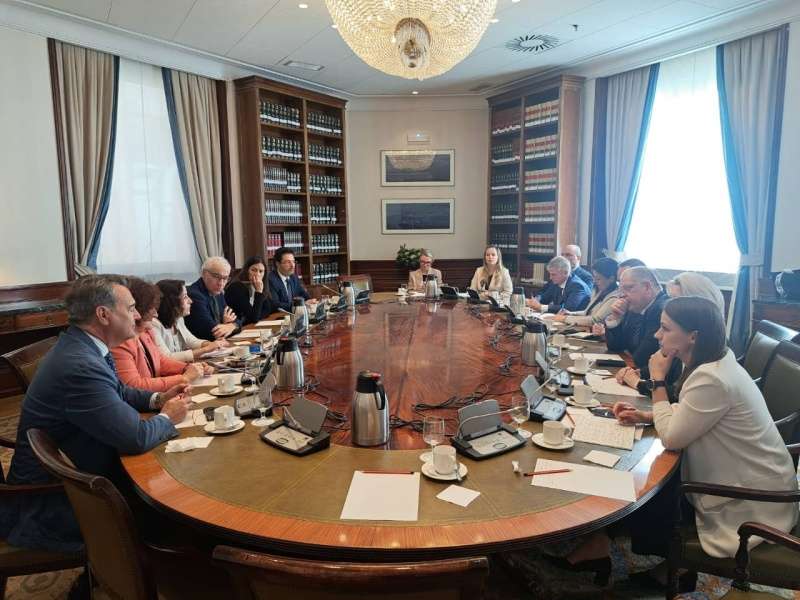
Participants of the United4Ukraine delegation also stressed the need for a complete phase-out of russian energy resources. Some Spanish private companies still import russian liquefied natural gas. At the same time, the recently adopted European regulation on ending such imports and related contracts by 2027 is regarded by both politicians and government officials as a necessary step towards finally abandoning the purchase of russian energy resources.
Ivanna Klympush-Tsintsadze noted that attention to the russian-Ukrainian war has significantly decreased amid other geopolitical crises and wars. That is why it is important to continue active communication with Spanish society, media, politicians, and the expert community.
“It was important for us to engage with the media and encourage our Spanish political colleagues to explain more actively to Spanish society the challenges posed by russia, including for Spain itself: potential threats, hybrid threats, threats in the cognitive sphere, as well as psychological and information attacks and manipulation within society,” she stated.
During the visit, the United4Ukraine delegation also met with experts and analysts researching information campaigns, psychological pressure, and the influence of hostile narratives in European societies. According to Ivanna Klympush-Tsintsadze, the challenges faced by Ukraine, Spain, and the European Union as a whole in this sphere are shared.
The Chair of the Committee also expressed gratitude to partners from the Baltic states and Poland, who joined the visit together with the Ukrainian delegation and actively contributed to organising the programme. The delegation included, in particular, the chairs of parliamentary committees on European and foreign affairs from Estonia, Poland, Lithuania, and Latvia.
“It is extremely valuable for us that our partners from the Baltic countries and Poland have become actively involved in organising this visit. The fact that they are dedicating additional time and effort to building direct ties with countries located farther from the eastern flank of the European Union and NATO is very important to us,” said Ivanna Klympush-Tsintsadze.
According to her, the participation of partners from other countries strengthens Ukraine’s voice and helps convey to Spanish counterparts a shared understanding of the threats that russia poses to the whole of Europe.
“It is very important for Ukraine that we are not alone in this struggle. And it is important not only to preserve the assistance we are receiving today, but actually to strengthen, reinforce, and increase it,” the Chair of the Committee concluded.