The Parliamentary Association Committee (PAC) is a key body for interparliamentary cooperation, established in accordance with Article 467 of the Association Agreement between Ukraine and the EU. In 2025, the Committee's work took on strategic importance in terms of Ukraine's preparations for accession to the European Union.
— Tell us about the Committee's work in 2025.
— In 2025, the Committee adopted a number of extremely important decisions. Following the European Parliament elections, a new European delegation was formed, and with it, the European part of the Association Committee. So, together with our colleagues, we had to essentially restart the Committee's work.
We agreed that, in addition to implementing the Association Agreement, the Committee would be very actively involved in preparing Ukraine for the negotiation process with the European Union.
For this purpose, a separate subcommittee was created this year—the Subcommittee on Accession Negotiations. As of today, all formal legal procedures have been completed. We are currently drawing up its agenda and awaiting proposals from our European colleagues on its content so that cooperation between the European Parliament and the Verkhovna Rada of Ukraine can be clearly planned for next year.
— What role does the Ukrainian part of the PCA play in shaping European policy on the russian-Ukrainian war?
— The Ukrainian part of the Committee consists of MPs representing various factions, groups, and committees. Therefore, we pay special attention to inter-committee cooperation between the Verkhovna Rada of Ukraine and the committees of the European Parliament in areas that are key for us.
Our colleagues hold joint committee meetings, agree on the implementation of projects, and organize round tables and other events. This allows us to develop common positions so that the negotiation process and other urgent issues for Ukraine can be resolved more quickly and effectively.
— What decision do you consider to be the most significant in 2025?
— The most important decision was undoubtedly the decision to establish a subcommittee to support the negotiation process. It reflects the European Parliament's clear political will to facilitate the earliest possible start of negotiations, to assist Ukraine in formulating its negotiating positions, and to assist directly in the process itself.
Equally important is the involvement of other parties in the joint work, in particular the Government of Ukraine and the European Commission.
— What further steps do you consider critically important in 2026?
— We have already prepared a work plan for 2026. In February, we plan to hold a joint meeting of the Association Committee in Kyiv, at the Verkhovna Rada of Ukraine.
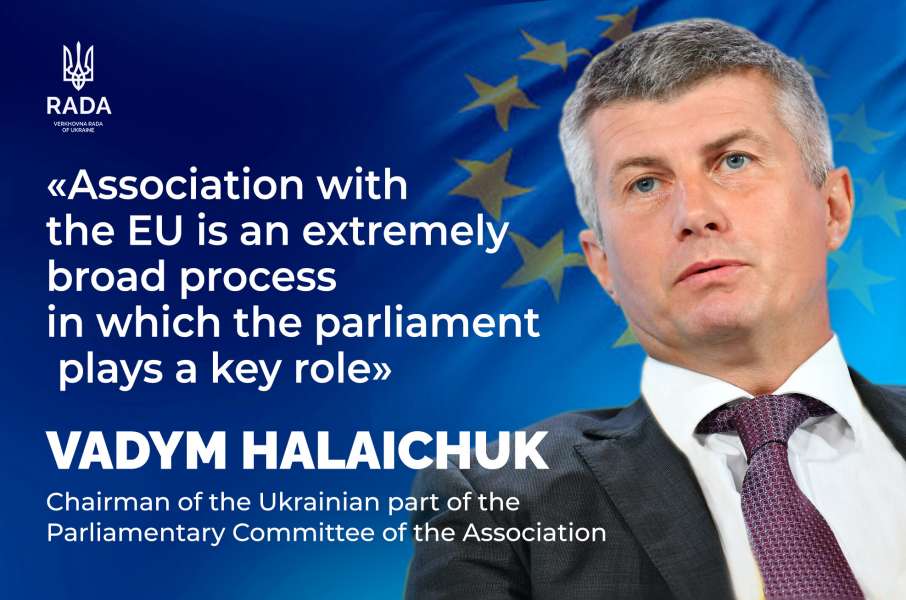
The focus will be on the negotiation process: opening clusters, forming negotiating positions, and achieving specific benchmarks. The Association with the EU is an extremely broad process in which parliament plays a key role.
Key areas of work for the PCA in 2025
In 2025, the Committee focused on four strategic areas:
• Military support and security. The PCA emphasises Ukraine's legitimate right to self-defense in accordance with Article 51 of the UN Charter and calls for the establishment of reliable security guarantees. Future membership in the EU and NATO is seen as the best guarantee of long-term stability.
• Sanctions pressure. The Committee welcomed the adoption of the 16th package of sanctions in February 2025 and the 19th in November, which for the first time provides for a complete ban on imports of russian liquefied natural gas (LNG).
• Accountability and reparations. The PCA supported progress in establishing a Special Tribunal for the crime of aggression and an international compensation mechanism, emphasising russia's full responsibility for the destruction and suffering inflicted on Ukraine.
• Energy resilience. Condemning russia's attacks on Ukraine's energy infrastructure, the Committee calls on the EU to step up its support for strengthening energy resilience, especially ahead of the winter period.