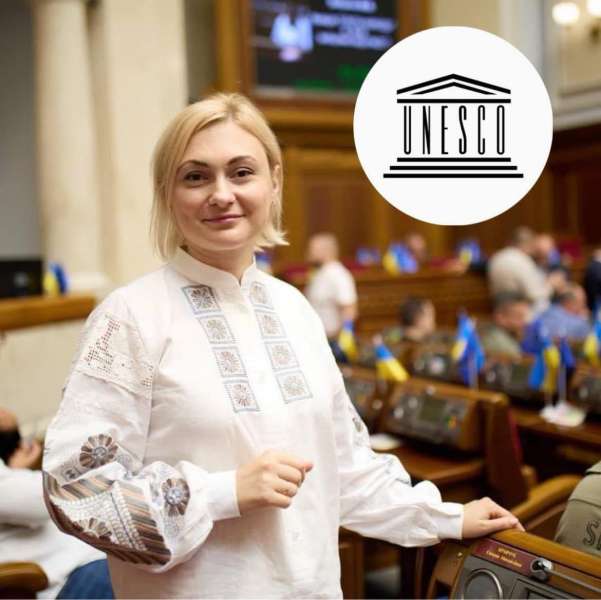
The Deputy Chairperson of the Committee on Humanitarian and Information Policy, member of the National Committee of the UNESCO IFAP – Information for All Programme Yevheniia Kravchuk took part in a meeting of the members of the Ukrainian IFAP National Committee with the Coordinator for Ukraine of the UNESCO Secretariat's Communications and Information Sector Andrea Cairola and the managers of the UNESCO Office in Ukraine Teresa Korbacher and Diana-Ivanna Moshkovska on cooperation with the organisation.
The meeting was also attended by members of the Ukrainian IFAP National Committee Larysa Levchenko, Ihor Rozkladai, Oleksandr Shevchuk, and Nina Kramareva. The Ukrainian committee is headed by Olha Gerasymiuk, the Chairperson of the National Council.
“The focus is on supporting Ukrainian media and journalists. I stressed that UNESCO should take a more active stance in condemning the crimes of the russian federation, in particular against our media and media workers. Ukraine should remain an important item on the organisation's agenda. After all, russia is trying every day to destroy Ukrainians’ access to free media, in particular in the occupied territories, and to spread its criminal propaganda,” said Yevheniia Kravchuk, the Deputy Chair of the Committee on Humanitarian and Information Policy, following the meeting.
According to her, despite all the challenges of the war, Ukraine holds the bar quite high in the media sphere. The latest ranking by Reporters Without Borders shows that: Ukraine has improved its position in the Press Freedom Index 2024, rising by 18 positions over the year – from 79th to 61st place.
Andrea Cairola spoke about UNESCO's objectives and its strategy to help Ukraine, launched after the full-scale invasion of russia. The strategy includes the protection and safety of journalists, support and training, logistics, preservation of documentary heritage, and recording damage and destruction of cultural monuments. The organisation's work plan also includes media literacy projects. UNESCO currently offers a variety of grants, training, and microgrants for media and NGOs.
The committee members expressed interest in participating in UNESCO's international events to keep the world's attention on Ukraine. They discussed the possible support of the organisation for the members of the National Committee in carrying out such activities.
Yevheniia Kravchuk suggested that during the next international UNESCO event, an exhibition about captured Ukrainian journalists in russian custody should be organised. In her opinion, it would be appropriate to hold such an exhibition at the UNESCO headquarters in Paris.
As noted by Ihor Rozkladai and Larysa Levchenko, the preservation of documents from Crimea, as well as the documentary and cultural heritage of small towns, museums, and cultural sites, deserves special attention. After all, russia is pursuing a deliberate policy of removing and destroying archives and monuments to erase the cultural, historical memory and identification of Ukrainians and other minorities living in our country.
Mr Andrea shared his opinion that it would be good for Ukraine to create national registers of what is a priority national cultural heritage. And the National Committee could take care of this issue.