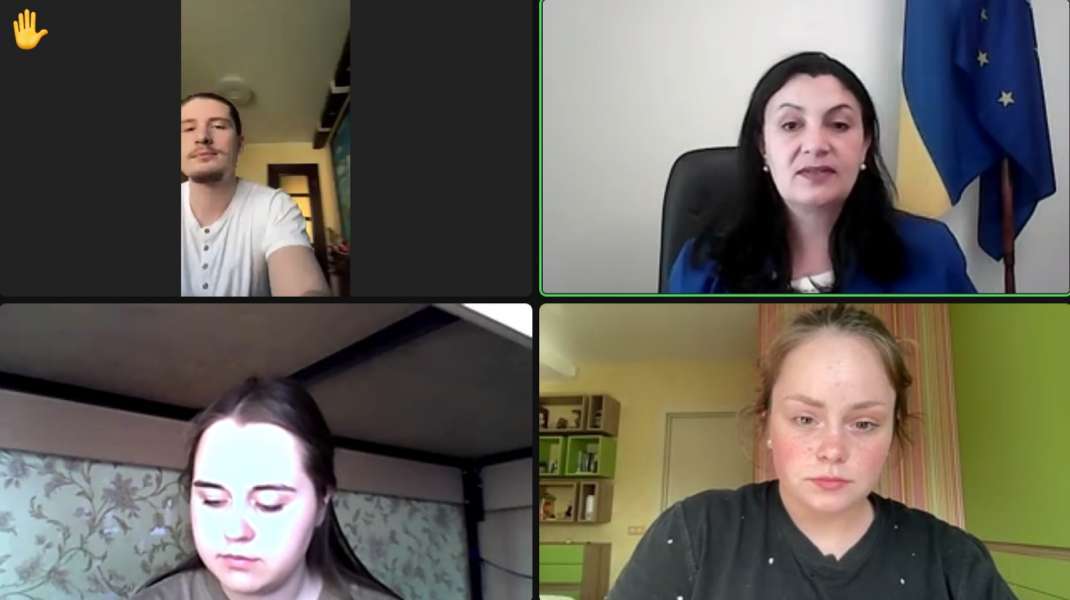
The Chair of the Committee on Ukraine's Integration into the EU Ivanna Klympush-Tsyntsadze emphasised this during a lecture for participants of the NATO PA Youth Model. The lecture was devoted to the impact of the Committee’s work on accelerating the processes of accession to the EU and NATO.
Ivanna Klympush-Tsyntsadze noted that integration into the EU and NATO is not just about the rules and procedures that Ukraine should adopt from the EU member states or the approaches and principles of the NATO member states. It is also about the fundamental transformation of Ukraine and the involvement of the entire society, at all levels – from government to civil society. “This is not an easy path, which in our case has to be implemented during the bloody war that has been going on for eleven years,” said the Committee Chair.
She noted that the role of the Verkhovna Rada in general and the Committee on Ukraine's Integration into the EU in particular in this process is extremely important. The Parliament, she said, is the main legislative body that should form the framework in which the country will continue to move. At the same time, the role of structuring the processes of European and Euro-Atlantic integration still belongs to the government, which should propose an algorithm for implementing certain tasks.
According to its chairman, the Committee on Ukraine's Integration into the EU has a political and technological role to assess Ukrainian legislation for compliance with EU law. “We must understand that about 70-80 per cent of the tasks we face in the field of political transformation, the rule of law, respect for democratic rights and freedoms are all things that are professed by both the European Union and the Alliance. That is why our adoption of legislation in Ukraine, in line with the norms of the European Union, brings us closer to both standards and NATO membership every day,” said the Committee’s chairperson.
Today, she said, the Committee has several main functions. These include analysing legislation for compliance with EU law and Ukraine's international commitments, exercising parliamentary control, and inter-parliamentary cooperation. In the context of inter-parliamentary cooperation, there are several tools that the Committee on Ukraine's Integration into the EU uses in its interaction with foreign colleagues. The Committee is responsible for the activities of the Verkhovna Rada's permanent delegation to the EU-Ukraine Parliamentary Association Committee (PAC). This work involves interaction with MEPs and often results in a basis for promoting an important agenda for Ukraine. It also participates in the Euronest Parliamentary Association. With the acquisition of candidate status, Ukraine became a permanent member of another inter-parliamentary forum, COSAC, the Conference of Chairmen of the European Affairs Committees of the EU Member States. It is an important forum for promoting Ukrainian interests among parliamentarians of the format's member states. Another important platform where Ukraine is represented is COSAP – the Conference of Parliamentary Committees on European Integration/Stabilisation and Association Process States in South Eastern Europe. According to Ivanna Klympush-Tsyntsadze, participation in this forum is also useful because some of the participating states are already NATO members. Thus, cooperation in this format helps to promote Ukraine's Euro-Atlantic interests. The participation of Ukrainian delegations in the NATO-Ukraine Interparliamentary Council and the NATO Parliamentary Assembly is also important. “The NATO PA was the first assembly to get rid of the russian delegation in its work. It was important for us that at the end of the 14th year, the Ukrainian team began to actively participate in the preparation of reports, submit its proposals and shape the political agenda, and promote important issues in cooperation with NATO member states,” the Committee Chair said. She noted that until now, the NATO PA consisted of 8 members and alternates.
“Now it can be increased to 12 members. Ukraine will have 12 members in this organisation when it joins NATO. Therefore, Ukraine will be able to use this increase as an opportunity to promote its interests even more effectively,” said Ivanna Klympush-Tsyntsadze.
During the discussion with the participants of the lecture, the Chair of the Committee also touched upon the obstacles to joining the Alliance. “If Ukraine not only declared what it wants as loudly as possible, but also did its homework very carefully, responsibly and honestly, we would have fewer problems with sceptics who use the situation to say that Ukraine is not ready,” said Ivanna Klympush-Tsyntsadze. According to her, in accordance with the decision of the Vilnius Summit, Ukraine does not need to have a NATO Membership Action Plan to join the Alliance. De facto, this function is entrusted to the Annual National Programme of Ukraine-NATO cooperation. ‘The Government approved the ANP at the end of December last year. Now we are at the end of May this year. I have not seen a single draft law from the Government that would be submitted to the Verkhovna Rada of Ukraine to implement the Annual National Programme. We not only have to demand, but we have to look at ourselves honestly in the mirror in terms of transforming the country,’ said Ivanna Klympush-Tsyntsadze.