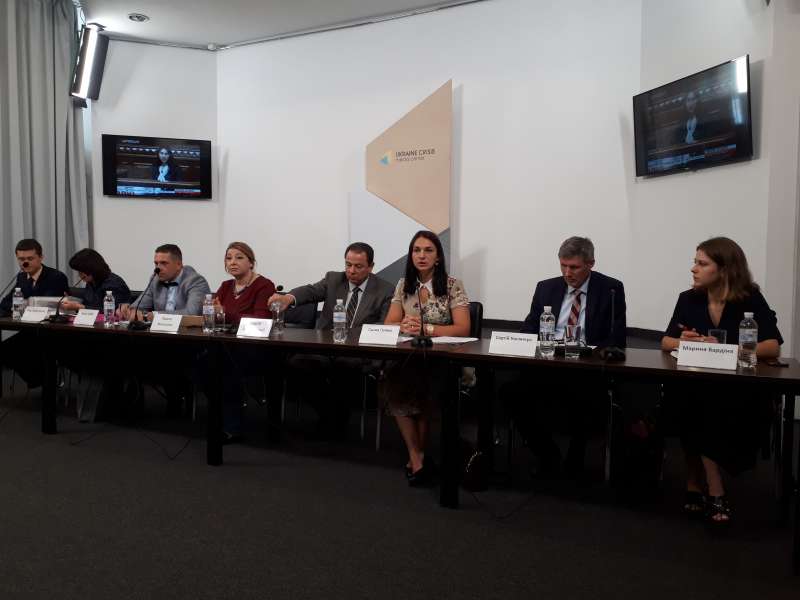
Under H.Hopko’s headship, there were held 153 committee meetings, with 1,080 and odd issues addressed. The vast majority of the above issues considered were draft laws and resolutions dealing with various bearings of Ukraine's foreign policy and external relations, ratification of international agreements, in particular on foreign economic activity, migration and other issues.
The сommittee has worked through 228 draft laws, resolutions and other acts of the Verkhovna Rada of Ukraine, 160 of which were adopted on the second reading and in tote.
“The infamous comeback of the Russian delegation to PACE as well as Putin's sneaking out of the international isolation do both testify a dire necessity for much more coordinated actions. We should not enable a scenario where Ukraine and not the aggressor would be coerced into compromise. That is why the Parliament, the Ministry of Foreign Affairs and the President should act as one national team in the future,” Hanna Hopko, the committee head, emphasized.
Along with the need to strengthen the anti-Putin coalition and the sanction pressure upon the Kremlin, among Ukraine’s foreign policy priorities there were determined implementation of the European Plan for Ukraine 2027, resistance to the construction of the Nord Stream 2, recognition of the Holodomor 1932-1933 as an act of genocide against the Ukrainian people.
Hanna Hopko also offered a sound advice to newly elected parliamentarians to focus on the release of Ukrainian hostages.
"Ukraine has every chance of becoming a leader in Eastern Europe in the next six years, and its mission is to contain the offensive of the aggressor against European Civilization and democratic values," Hanna Hopko averred.
As scrutinizing the Russian Federation - the aggressor state was defined there one of the priority tasks for Ukraine in the coming years by an official of the Ukrainian Institute of National Remembrance Pavlo Podobied. A system of in-depth researches makes the footing for administering foreign policy of leading states in relation to objects of their interests.
Therefore, supporting both governmental and non-governmental organizations that will study the Russian Federation through the prism of understanding the complex problems, the roots of conflicts between different nationalities of the Russian Federation, and how Ukraine should position itself, is a task of high importance.
It was also stressed that when developing Ukraine’s foreign cultural policy there should be taken into consideration not only achievements of the last five years, but also the well-known events of a century ago.
Larysa Voloshyna, journalist, focused on the issue of information warfare and ways of countering the Russian information aggression: "The Russian Federation has consistently pursued its policy in two directions: integration of the occupied territories and legalization of Crimea’s annexation".
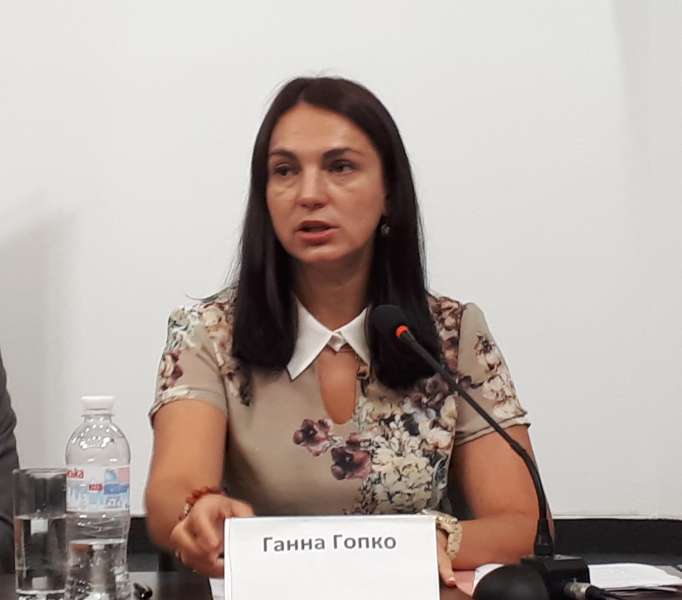

She advised that meaning be given to those Verkhovna Rada’s decrees, which recognize the Russian Federation as an aggressor state and the occupation of Ukraine’s territories. "Now, there is an opportunity to utilize the stable majority in the Verkhovna Rada for the benefit of Ukraine," L. Voloshyna underlined.
She also stressed the need for additional legislation to support the indigenous languages.
"Communication between the authorities and the press should not be based on personal contacts between politicians and journalists or, for instance, leaks, but through open media activities," the journalist asserted.
Director of the Diplomatic Academy of Ukraine Serhii Korsunskyi stated that "within the first three years of the war, we have managed to defend Ukraine's position and create an anti-Russian front, but failed to develop the right strategy".
"Today, our community of experts is working hard on a foreign policy strategy, and its implementation requires a close and dynamic interaction," the academy director emphasized.
The Ukrainian World Congress Chairman Serhii Kasianchuk made special reference to the close cooperation of the UkrainianWorld Congress with the Committee on Foreign Affairs, which became apparent in supporting Ukraine in these difficult times in various spheres: humanitarian, religious, educational, informational, and economic. Supporting Ukraine’s European integration aspirations, strengthening the Western coalition, creating a holistic approach, combating the Nord Stream 2, assisting the Ukrainian Armed Forces, and releasing political prisoners - are all tasks for the very near future.
Also emphasized was the need for legislative regulation of support for the diaspora, migrant workers, and preservation of Ukraine’s identity.
A newly elected member of parliament Maryna Bardina thanked for a good communication when transferring the committee’s knowledge and experience: "The defined European integration course will be preserved”.
“We stand for a multi-party approach in shaping the foreign policy," M. Bardina emphasized.