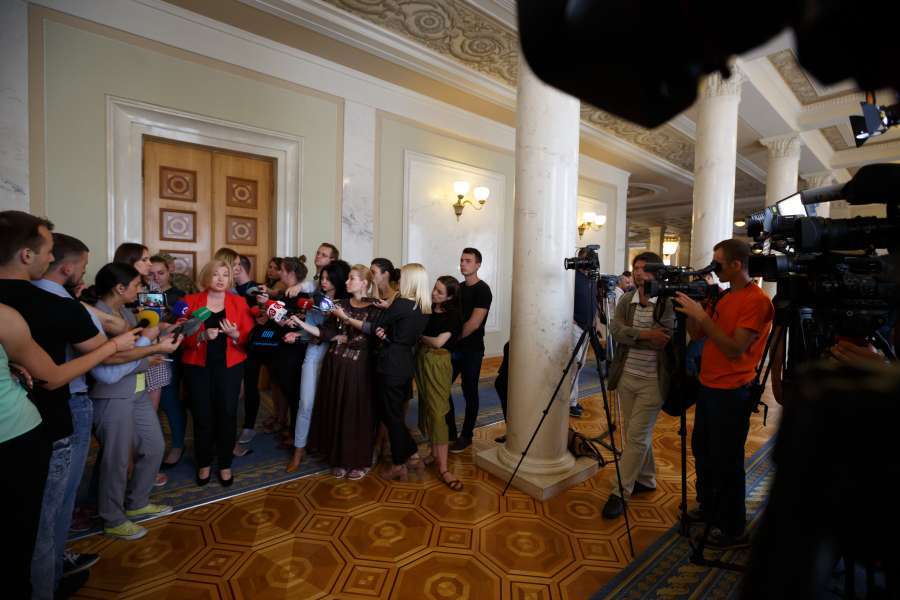
The First Deputy Chairperson of the Verkhovna Rada of Ukraine Iryna Herashchenko, giving her comments on the results of the June 5 meeting of the TCG and its working subgroups in Minsk, welcomed the resumption of peace talks, underscored that there is no alternative for political and diplomatic instruments of settling the situation in the Donbas. She also paid attention to a number of statements that had been recently made - dangerous ones, in her opinion.
In particular, according to the politician, the meeting resulted in demands and commitments for only the Ukrainian side without even mentioning the Russian Federation and the OSCE in the process of ensuring security and peace.
Iryna Herashchenko stressed that she does support all steps towards releasing hostages and improving the humanitarian situation, however “there are red lines that cannot be crossed in the negotiations". Surprisingly, there was no call to Russia demanding to observe silence and to the OSCE SMM regarding the need to monitor the security situation 24 hours a day and seven days a week, as well as the need to monitor the waters of the Azov Sea.
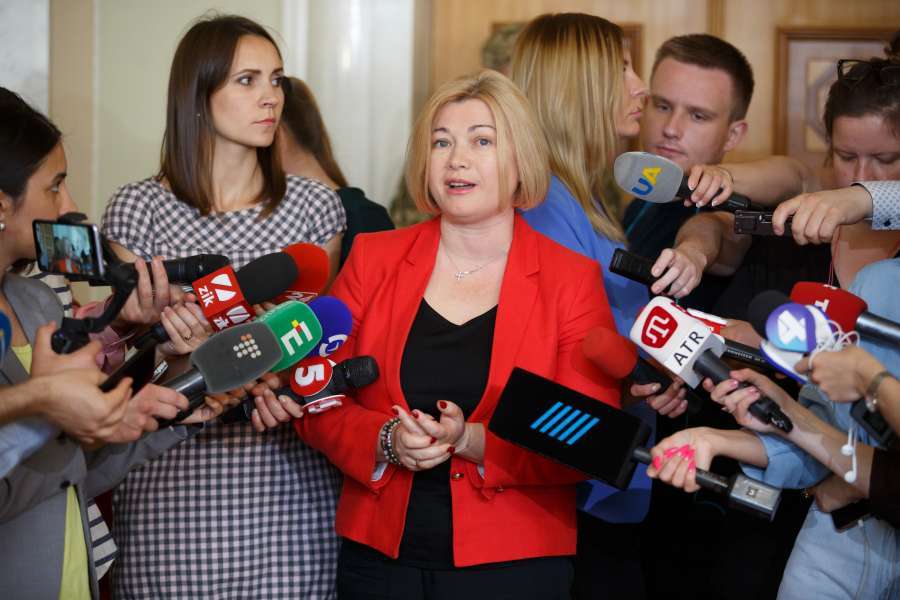
Regarding the would-be lifting the economic blockade on the Donbas, Iryna Herashchenko reminded that on March 15, 2017 the National Security and Defence Council of Ukraine suspended economic ties with the occupied territories due to the impudent expropriation of state-owned and private enterprises by the Russian Federation, the introduction of the Ruble zone and the Russian tax system in the occupied Donbas. She stressed that there had been the Russian presidential decrees that led to the abovementioned consequences.
"Unfortunately, we can presently hear not a sneeze of appeal to the Russian side to abolish those presidential decrees regarding the seizure of Ukrainian enterprises, the recognition of ORDLO documents as well as the decree on illegal “passportization” of Ukrainian citizens in the occupied Donbas," Iryna Herashchenko unfolded.
The first vice-speaker also noted the need to intensify the work of the OSCE Special Monitoring Mission in the Donbas. According to her, the OSCE mission should monitor the security situation there in a 24/7 regime, in particular in the waters of the Kerch Strait as well as the Azov and Black Seas.
The politician reminded about the directives the Ukrainian negotiators in Minsk had been guided through, which provided for building up an OSCE monitoring point in Kerch.
The politician noted that the Ukrainian side had initiated 19 armistices, all of which were violated by the Russian Federation and the occupying forces. "Ukrainian soldiers have always been clearly commanded not to use weapons during a truce, but it is obvious that when there is a danger to life and shelling of our fire lines begins, they do have the right to use their arms in return," I.Herashchenko explained.
She then stressed the urgency of creating an additional working group within the TCG format, which would be in charge of the border problems. The politician then underlined that there would be possible to stop supplying of arms, equipment, Russian military personnel and hired guns to the Donbas only provided that the 400 km of the Ukrainian-Russian border be put under control of the Ukrainian government.
The first vice-speaker noted the importance of reconstruction of the bridge in Stanytsia Luhanska. She reported that the Russian Federation and the occupying forces had never adhered to the silence regime in this area, constantly changing their position regarding the technical characteristics of the bridge at issue.
"In Minsk, we have always insisted upon the political and diplomatic ways of resolving the situation in the Donbas, and we will surely welcome if, as a result of the new negotiations, it will be possible to unbar the release of hostages, political prisoners of the Kremlin, prisoners of war and settle other humanitarian problems of the Donbas," she stressed.
Iryna Herashchenko expressed her conviction that protection of Ukraine’s national interests and ending the war remain among the tasks of highest priority for the Minsk groups.