Recently, the Verkhovna Rada adopted the Law (Reg. No. 13478-1) on the phased restoration of merit-based competitions for civil service and local government positions.
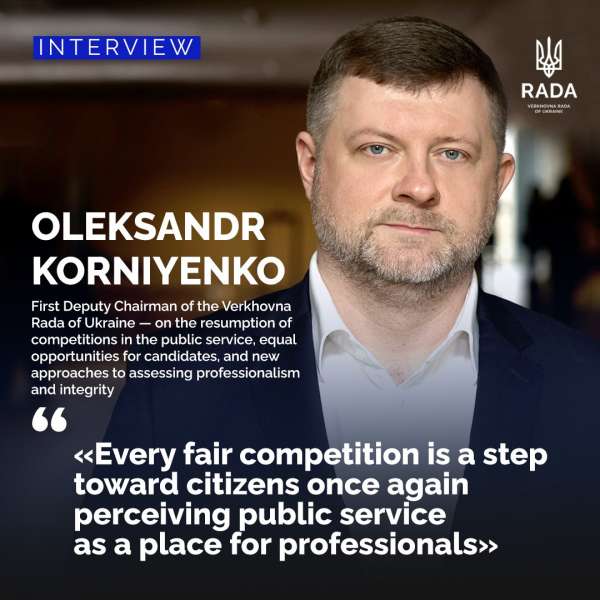
How the return of competitive selection will take place, what changes await candidates and current civil servants, and how the new rules will help attract professional experts—First Deputy Speaker of the Verkhovna Rada of Ukraine Oleksandr Korniyenko discussed these issues in an interview with the Press Service of the Secretariat of the Verkhovna Rada of Ukraine.
Why is the restoration of merit-based competitions for civil service a crucial step for the public administration system?
The adoption of the Law is an important step toward restoring open and professional recruitment to the public service. The competitive mechanism must ensure equal access to positions and create more opportunities to attract specialists with diverse competencies and professional backgrounds. For me, this is one of the key issues for the entire public administration system. Without strong professionals, it is impossible to ensure the high-quality operation of state institutions and the implementation of reforms. The civil service comprises more than 190,000 positions, over 30,000 of which remain vacant. It is essential to me that this Law is not just about procedures, but also about trust. People must see that individuals join the public service based on knowledge, experience, and reputation. That is precisely why integrity becomes a mandatory component of the selection process. A state that is trusted is a state where an official is accountable for their decisions and prepared for transparent scrutiny. Every fair, transparent competition is a step toward making citizens view the public service once again as a place for professionals.
Is it important to restore competitions even under the conditions of full-scale war?
Under the conditions of ongoing war, the civil service needs professional experts more than ever—individuals who will join the civil service and work daily to bring victory closer, rebuild our state, and advance our accession to the EU and the OECD. While the Unified Civil Service Vacancy Portal remains inactive, candidates in the labor market are unable to view all open civil service vacancies and, consequently, cannot consider them alongside private-sector opportunities. The state must guarantee such professionals access to the civil service based on merit, while simultaneously ensuring their safety. The personnel deficit, the ambitious goals facing the civil service, and Ukraine's international commitments necessitate the restoration of transparent, merit-based recruitment. This is essential for enhancing the state apparatus's capacity to respond to present-day challenges. These commitments are enshrined in the Ukraine Facility Plan and the Public Administration Reform Strategy of Ukraine for 2026–2030. The Strategy provides for the restoration and modernization of meritocratic selection on a revised legal foundation, utilizing open competitions and elements of a career progression model for internal candidates. It also provides for a fully digital competition cycle via the Unified State Web Portal of Electronic Services.
A prolonged suspension of transparent competitions diminishes public trust in the civil service and causes concern among the professional community, which loses faith in open access to public service and ceases to view it as a path for career advancement. It also raises concern among Ukraine's international partners, who consistently emphasize the need to build civil service capacity for successful reconstruction and European integration.
It is important to note that the restoration of competitions does not mean the immediate dismissal of individuals appointed during martial law. The transition to a competitive system will take place according to the rules and timelines established by Law, which vary depending on the position category and the specific employee's situation.
Therefore, it is essential not to rely on general assertions or rumors, but to verify which transitional rules apply to a given situation. The impact of restoring competitions on a specific position will depend on the position category, the method of appointment, performance evaluation results, and other conditions provided for by law.
What model for restoring merit-based selection does the Law provide?
Simplified appointments without competition are being replaced by a legally established schedule for the restoration of competitive selection — specified separately for Category "A", "B", and "C" positions, as well as positions in local government bodies occupied by individuals appointed without a competition prior to the entry into force of this Law.
Competitions will be announced according to the following schedule:
Category "A"—from the date of entry into force of the Law, with a deadline for announcement of 12 months.
Category "B"—after 1 month, with a deadline for announcement of 12 months.
Category "C"—after 2 months, with a deadline for announcement of 18 months.
Local self-government bodies—after 2 months, with a deadline for announcement of 18 months.
The maximum terms for holding a position without a competition will be up to 18 months from the date of entry into force of the Law for Categories "A" and "B", and up to 24 months for Category "C" and local self-government bodies. The determination of a competition winner constitutes grounds for the dismissal of the individual temporarily occupying the position without a competition.
Furthermore, the Law provides for the possibility to continue the service without competition for Category "B" and "C" civil servants and local self-government officials who have received a positive or excellent rating according to their performance evaluation results. This requires their consent and a decision by the head of the agency, which may be issued within three months following the entry into force of the Law.
It is important that competition to fill vacant civil service positions across all categories, as well as vacant positions in local self-governance bodies, can be announced from the date of entry into force of the Law. At the same time, the requirements for the restoration of competition do not apply to positions in state bodies and local self-government bodies located in the active combat zones or temporarily occupied territories.
Will current civil servants have an automatic advantage over external candidates? How does the Law regulate career growth within the system?
The mere fact that a person is already working in a state body does not mean an automatic advantage over other candidates in an open competition. If a current servant and candidate take part in the same open competition, they undergo the selection in accordance with the rules established for that competition.
At the same time, the updated model intentionally creates opportunities for career development for individuals who already are public servicemen. This requires internal competition to be introduced—a distinct mechanism that allows employees to apply for other positions within the system.
This is not an advantage of a current employee over an external candidate within a single competition, but a special instrument for professional and career development. Internal competitions are also designed to help fill vacancies more rapidly by leveraging the experience and competencies of personnel already serving in the relevant authority. Separately, the Law provides for transitional mechanisms for certain employees hired without a competition during martial law, as well as rules for specific categories of candidates.
What specific changes are provided for in the competitive selection procedure? How is it possible to make it clearer and more predictable for candidates?
The Law provides for clearer timelines for conducting competitions. For Category "A", the document submission period will be 15–30 days, while for Categories "B" and "C" it will be 10–30 days. The results of competitions for Category "A" must be published within 90 days, and for Categories "B" and "C" within 60 days. For internal competitions, the document submission period will be 5–10 days, with the publication of results completed within 30 days.
Provision is also made for streamlining procedures regarding appeals, suspensions, and cancellations of competitions, as well as deferred rights to assume office and repeat competitions.
Another key change is the ability to identify candidates who do not meet position requirements at an early stage of the selection process and exclude them from subsequent stages. This is intended to reduce the workload on state bodies and selection commissions. The Law also regulates candidate participation in multiple competitions within a given period.
To perform temporary tasks, a more flexible mechanism for engaging specialists is provided through a civil service contract. Such a contract may be extended once for a term of up to three years.
The number of such positions may not exceed 7% of the total staff ceiling for Category "B" and "C" positions in the relevant body.
What new mechanisms will help evaluate the competence and integrity of candidates?
The Law provides for the introduction of an integrity declaration—a new tool for gathering information on candidates. It will be submitted by candidates for Category "A" positions, as well as candidates for Category "B" and "C" positions with high corruption risks. The list of such positions will be approved by the Cabinet of Ministers of Ukraine. This new requirement will enter into force 12 months after the Law takes effect.
The selection commission will be authorized to request materials from the National Agency of Ukraine on Civil Service (NAUCS) regarding a candidate's compliance with integrity criteria. For this purpose, NAUCS will have the right to obtain necessary information, including restricted information.
Mandatory training is also mandated for members of the Senior Civil Service Commission and selection commissions on assessing candidates' professional competencies. Such training will be organized by NAUCS. Decisions of selection commissions will be documented in minutes signed within a specified timeframe by all members who participated in the meeting. This is intended to unify evaluation approaches, improve selection quality, and enhance transparency in personnel decision-making.
What additional transparency tools does the Law provide for? Will the public be able to monitor how selection for leadership positions is conducted?
For competitions regarding Category "B" and "C" positions, video recording may be conducted upon a decision of the selection commission.
Additionally, a mandatory motivation letter is introduced for Category "A" positions, in which candidates must outline their core values, motivation, and professional vision for the role. Furthermore, the National Agency of Ukraine on Civil Service (NAUCS) will publish a video recording of the interview with the competition winner for Category "A" positions on its official website within five working days following the determination of the results.
The Law also provides for the public disclosure of not only the winner, but also the runner-up candidate for Category "B" and "C" positions, where applicable. The appointing authority must notify the winner and provide the list of documents required for appointment within five calendar days after the publication of the results. Combined, these mechanisms are designed to make the selection procedure more open and ensure public traceability of its outcomes.
What advantages will veterans of war have during the competitive selection? Does the priority right mean that a veteran can be appointed instead of a candidate with better results?
The Law provides for a priority right to appointment for candidates with war veteran status. However, this does not imply an automatic appointment solely on the basis of such status.
Veterans participate in the competitive selection on a general basis, must meet the established position requirements, and undergo the evaluation stages prescribed for the competition. It is essential to distinguish between participation in a competition under general conditions and the exercise of a priority right. As a general rule, candidates are evaluated against the requirements and criteria established for the respective position, and the winner is determined based on the outcomes of the competitive selection.
Veteran status in itself does not substitute for the assessment of professional qualifications, nor does it mean that a candidate with a lower score automatically becomes the winner. The priority right applies exclusively in the circumstance explicitly defined by the Law: when candidates achieve identical results upon completion of the competition. In such cases, preference in determining the winner is granted to the candidate who holds the priority right established by Law.
Are other priorities provided for candidates? Specifically, how will the new Law support young professionals?
In addition to war veterans, the Law establishes priority rights to appointment for youth who have completed an internship in the relevant body. Furthermore, in the event of equal scores, provision is made for positive action measures to promote gender balance.
These mechanisms are intended to create additional opportunities for specific categories of candidates under the circumstances and conditions defined by legislation. At the same time, they do not waive the requirement to meet position qualifications and undergo competitive selection.
How will the search for civil service vacancies change? What role will Diia play in this process?
The functions of the suspended Unified Civil Service Vacancy Portal are being transferred to the Unified State Web Portal of Electronic Services—Diia—which will serve as a single entry point for applicants.
This is intended to make vacancy searches more user-friendly: rather than searching for announcements across the individual websites of separate authorities, candidates will be able to use the Unified State Web Portal of Electronic Services. In this way, digitalization will encompass the entire competition lifecycle, making access to civil service vacancies more centralized and transparent for prospective applicants.
What systemic challenges within the civil service is the updated competitive procedure intended to address?
First and foremost, it aims to ensure access to civil service positions for the top candidates from the broader labor market as well as qualified internal applicants, tailored to the essential needs of the state.
Currently, due to the suspension of competitive recruitment, each public authority has established its own localized practices for recruitment and evaluation. This fragments the process for candidates, reduces transparency for Ukraine’s international partners, and impedes proper monitoring of the quality and integrity of appointments.
Another key challenge is the lack of a unified framework to define the specific competencies and professional knowledge required for effective job performance. Individual authorities independently determine competency requirements and assess candidates based on their own operational capacity, which does not always align with the actual functional needs of the agency.
Furthermore, current regulations do not properly reflect the results of civil service job classification, which offer new opportunities to standardize competency requirements across job families and hierarchy levels.
The updated procedure is designed to establish unified civil service-wide standards for recruitment and assessment that can be deployed centrally with optimal resource utilization, while retaining the flexibility to adapt competitive approaches based on the level of the position and the specific authority.