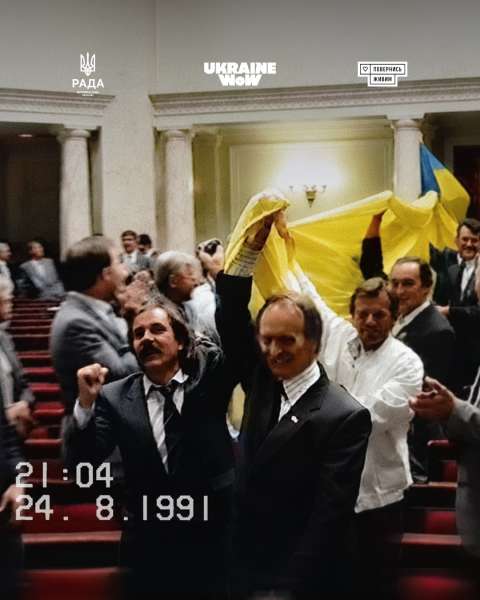
35 years ago, a group of Ukrainian MPs brought a flag into the Verkhovna Rada session hall. With its unusual color and size, it became the main witness to the declaration of Ukraine's independence. In August 2026, the NGO Ukraine WOW, together with the Come Back Alive Foundation and supported by the Verkhovna Rada of Ukraine, recreated this flag in one thousand copies so that it would unite people once again — and save lives.
Today, it is hard to imagine that during the Soviet era, people were persecuted by the KGB simply for displaying the Ukrainian flag. Finding fabric of the right colors was nearly impossible, as the secret services seized it from stores. That is why the flag, secretly sewn by activists of the People's Movement of Ukraine (Rukh), was light blue rather than dark blue, and measured 7 meters 34 centimeters long — exactly as much fabric as could be found. On August 24, 1991, it reached the walls of the parliament. At 9:04 PM, a group of MPs led by Vyacheslav Chornovil and Ivan Zaiets brought the flag into the session hall of the Verkhovna Rada of Ukraine. Every Ukrainian knows this iconic frame of documentary footage.
In 2026, the NGO Ukraine WOW and the Come Back Alive Foundation, supported by the Verkhovna Rada of Ukraine, recreated this flag — one thousand copies of the exact same color and size. Each flag has its own unique number and comes with a postcard hand-signed by Ivan Zaiets, one of the founding fathers of the modern Ukrainian state. You can receive a flag by making a donation of 40,000 UAH at https://dev.ukrainewow.org/prapor-nezalezhnosti. All proceeds will go toward purchasing unmanned ground vehicles (UGVs) for the Defense Forces of Ukraine.
“I remember that day down to the smallest detail,” says Ivan Zaiets. “We could hear thousands of voices outside the parliament chanting: ‘In-de-pen-dence, in-de-pen-dence!’. Initially, upon the proposal of the Chairman of the Verkhovna Rada, Leonid Kravchuk, the flag from a tank during the moscow coup was supposed to be brought into the plenary hall. But when I went out to the square in front of the parliament, it was nowhere to be found in the sea of blue-and-yellow flags. I was drawn to a large light-blue-and-yellow flag that people had been holding in their hands all day long. They hoped to see it above the dome of the parliament building as a herald of the birth of the new Ukrainian state. (I already had the experience, albeit unsuccessful, of bringing a blue-and-yellow flag into the hall on October 1, 1990, a day before the start of the Granite Revolution student hunger strike.) So we took this large light-blue-and-yellow flag and carried it into the hall. Afterwards, we sang ‘Chervona Kalyna’.
“I felt immense pride because I had the opportunity to be among the founders of the state. Such an opportunity comes, perhaps, once in a thousand years. And we did not waste that opportunity. It was a great happiness to become a flag-bearer of this state. We are a fortunate generation because we can see the result of our work, of our service to the people: an independent Ukrainian state — Ukraine.”
“On August 24, 1991, the light-blue-and-yellow flag was solemnly brought into the Verkhovna Rada. And on February 24, 2022, unfortunately, for the first time in our modern history, it had to be evacuated from the parliament building,” says Chairman of the Verkhovna Rada of Ukraine Ruslan Stefanchuk. “Until early April 2022, it remained in my backpack and stayed with us until russian troops were driven back beyond the borders of Kyiv region. Then the flag returned to its place of honor in the Verkhovna Rada of Ukraine. And there it will remain forever. The Flag of Independence is undoubtedly one of the most important symbols of our state. And I am glad that thanks to this project, it will be able to serve another crucial purpose — saving the lives of our military on the frontline and uniting people in their love for Ukraine.”
“It is deeply symbolic that an exact replica of the flag that witnessed the birth of an independent Ukraine 35 years ago will now help those who defend it. Today, our colleagues are also among Ukraine’s defenders. That is why this project holds special significance for us. It is important for us to support an initiative that connects our history with today’s fight for Ukraine,” noted Viacheslav Shtuchnyi, Head of the Secretariat of the Verkhovna Rada of Ukraine.
“We sought to recreate the very flag that is kept in the Ukrainian parliament today. And we were deeply moved when we measured it: 7 meters 34 centimeters long. This non-standard size serves as a reminder of how difficult it was not only to sew the flag, but even to find fabric of the right color. For the one thousand flags, we needed 26 kilometers of cloth and more than 2,000 hours of work. Four people worked on each copy. And Ivan Zaiets, a living legend, hand-signed a postcard for every single one. We believe that with these one thousand flags, people will receive a bit of the faith and strength so deeply needed to keep moving forward. If in 1991 Ukrainians managed to defeat the empire of evil and win independence when no one in the world believed it was possible, then we will succeed in standing strong today as well. We are sincerely grateful to those who believed in this idea and helped bring it to life: Accordbank, Nova Post, Taras Panasenko, and Anatoliy Reder,” comment the co-founders of the NGO Ukraine WOW, Yaroslava Gres and Yuliya Solovey.
All charitable donations will be directed by the Come Back Alive Foundation toward purchasing unmanned ground vehicles (UGVs) for the Defense Forces of Ukraine. These vehicles will be used to evacuate the wounded and deliver essential supplies — such as medical items, provisions, and ammunition — to the most dangerous sections of the frontline.
“Unmanned ground vehicles carry out the highest-risk missions in place of soldiers, medics, and drivers. For instance, where a single UGV can transport up to 500 kilograms of cargo in two hours with no risk to soldiers' lives, it would otherwise take 25 people who would have to stay within the hit zone of FPV drones, and significantly more time. That is why the frontline’s demand for such systems today is extraordinarily high, and equipping the military with them alongside training operators is one of the foundation’s top priority areas,” comments Oleh Karpenko, Deputy Director of the Come Back Alive Foundation.
Join the project: https://dev.ukrainewow.org/prapor-nezalezhnosti