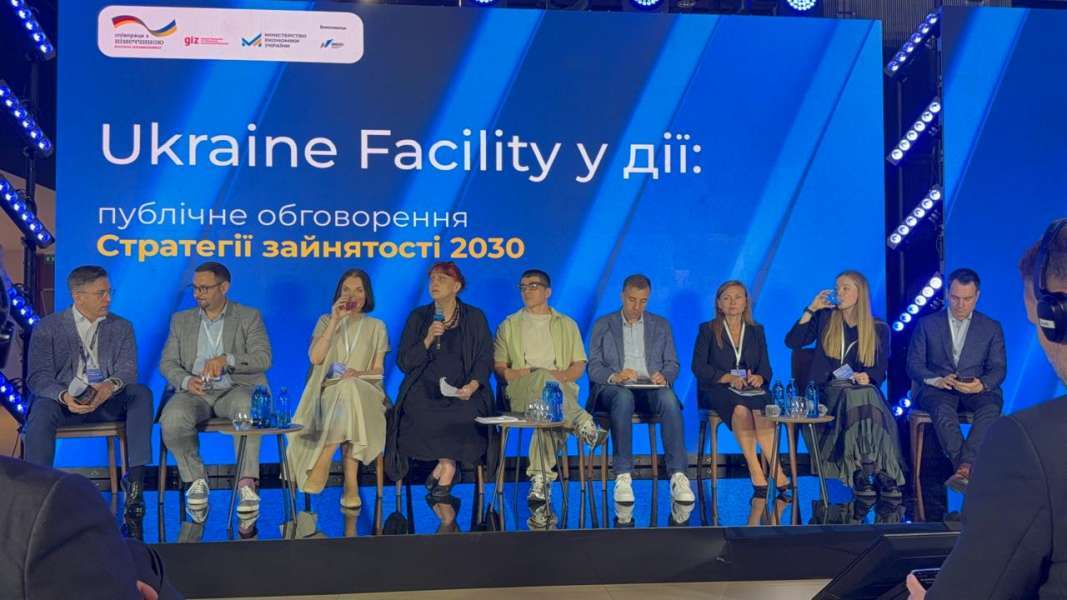
On July 3, 2025, the Chairperson of the Committee on Social Policy and the Protection of Veterans’ Rights Halyna Tratiakova took part in public discussion «Ukraine Facility in action: public discussion of Strategy Plan 2023,» organised by the Ministry of the Ukraine's Economy with the support of GIZ Ukraine and in cooperation with the BRDO. The event was also attended by Anatolii Ostapenko, Chairman of the Subcommittee on Social Protection of Veterans' Rights.
The event was held within the framework of the development of a new Strategy Plan, which aimed at forming renewed state policy in the field of employment, in view of modern challenges of the labour market. Among the challenges: massive migration, demographic decline, shadow employment, shortage of qualified personnel, and the need to integrate internally displaced persons.
The discussion focused on the key priorities of the future Strategy, including the development of human capital, promotion of productive employment, adaptation of policies to the challenges of the modern labour market, and improvement of the efficiency of state institutions in the field of employment.
The development of the Employment Strategy 2030 is one of the priorities under the Ukraine Facility Plan—a comprehensive framework aimed at supporting Ukraine’s economic recovery, structural reforms, and European integration.
The discussion brought together representatives of government institutions, the business sector, trade unions, the expert community, civil society, and international partners.
In her remarks, Chairperson of the Committee Halyna Tretiakova emphasized the need to embed a stronger social dimension into the forthcoming Strategy.
According to the Chairperson, employment is not only a key driver of gross domestic product (GDP), but above all, the foundation of well-being for Ukrainian families.
“Employment generates GDP. But it also provides families with the means to survive, to have a stable income, and a sense of well-being,” emphasized Halyna Tretiakova.
Drawing on examples from the history of philosophy, she recalled that even Aristotle distinguished between two types of employment: as a means of survival within the household, and as chrematistics—the art of accumulating wealth. She noted that today’s realities call for a renewed appreciation of the value of household economics:
“When we broke free from the grip of the Soviet system, we forgot that a household must have the right to freely engage in economic activity and accumulate savings. And those savings must be managed. That, too, is a form of employment,” she stated.
The Chairperson of the Committee also highlighted the importance of distinguishing between employment as a means of family survival—such as caregiving for children, the elderly, or persons with disabilities—and as a tool for capital accumulation through investment and financial activity. In her view, both dimensions must be taken into account in the development of strategic policy documents.
In addition, Halyna Tretiakova pointed out that the presentation materials lacked clear indicators of expected outcomes for citizens—specifically, what benefits individual Ukrainians will gain from the implementation of the Strategy.
Halyna Tretiakova also placed particular emphasis on the issue of “invisible labour”—specifically, unpaid domestic work, caregiving, and child-rearing. She noted that on 24 August 2024, the Law of Ukraine “On Amendments to Certain Legislative Acts of Ukraine on Regulating Domestic Workers’ Labour” No. 3680-IX entered into force. This law, she highlighted, is the first legislative act in the history of independent Ukraine to comprehensively regulate the legal status of domestic workers.
In the context of labour mobility, the Chairperson of the Committee also underscored the need for a renewed understanding of population mobility within the framework of post-war development. She categorized this concept into several key dimensions:
Territorial mobility — movement of internally displaced persons within Ukraine, as well as international migration from and to Ukraine, which requires dedicated regulatory mechanisms and integration policies.
Mobility as barrier-free access — ensuring employment opportunities for persons with disabilities, including the development of infrastructure for smart workplace accommodations. Halyna Tretiakova highlighted the increasing number of persons with disabilities, particularly children affected by the war, and the need to create not only personalized but also inclusive work environments for them.
Temporal mobility — the ability of individuals to independently determine their work schedules and hours. In light of the COVID-19 pandemic and the full-scale war in Ukraine, remote work, outsourcing, and outstaffing have become integral parts of the modern labour market, requiring proper normative and statistical recognition.
She also appealed to the Strategy developers not to turn it into a rigid doctrine, emphasizing that the challenges facing Ukraine require flexibility and the ability to quickly adapt strategic documents. She stressed that readiness for such changes must exist not only within the executive branch but throughout the public service as a whole — including the 156,000 people working in the state administration system.
In conclusion, she highlighted the need to revise the methodology for assessing unemployment and labour productivity. According to her, the current tools do not take into account the real forms of employment that are widespread in Ukrainian society today, especially in the post-war period.
She noted that the existing statistical methodology does not reflect the modern challenges faced by Ukrainian society amid war, labour market changes, the active development of flexible employment forms, and the growth of unaccounted labour that falls outside traditional definitions of work activity.
She also drew attention to the fact that the current methodology for assessing GDP per capita does not account for a significant portion of the "invisible economy" — including caregiving work, volunteer activities, temporary or non-standard employment. This distorts the overall picture of the country’s socio-economic condition and complicates the formulation of evidence-based employment policy.
Halyna Tretiakova further emphasized that employment assessment methodologies must consider their intersection with the social protection system, since an unemployed person is not always socially vulnerable, and conversely, a person not formally classified as unemployed may have no income at all.
“The employment strategy must be based not only on macroeconomic indicators but also on the real situation in families. Flexibility, adaptability, and methodological revision — these are the key principles that must form the foundation of the new policy,” summarized Halyna Tretiakova.
The event became a key communication platform for discussing strategic approaches to shaping state policy in the field of employment.