Romania Bans russian Symbols at Sporting Events: Parliamentary Committee on Youth and Sports Welcomes Colleagues' Principled Stance
29 June 2026, 13:36
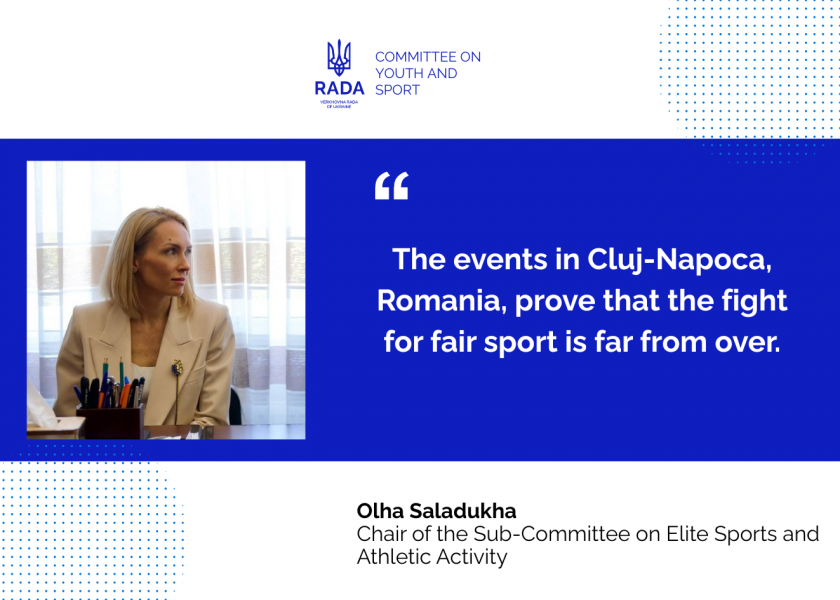
The events in Cluj-Napoca, Romania, prove that the fight for fair sport is far from over. This was stated by Olha Saladukha, Chair of the Sub-Committee on Elite Sports and Athletic Activity of the Committee on Youth and Sports, as she commented on the situation surrounding the gymnastics World Challenge Cup stage held in Romania.
According to her, the city mayor's decision to ban the use of the flag and anthem of russia during the gymnastics World Challenge Cup stage became a principled political and legal stance aimed at safeguarding the rules of international sports competitions and preventing the use of symbols of the aggressor state.
"When the community agreed to host the tournament, rules were in place that banned the use of the national symbols of the aggressor state. Despite the fact that the International Gymnastics Federation lifted these restrictions under pressure from the russian lobby, the Romanian side stood by its principles. It is decisions like these that deserve respect,” Olha Saladukha noted.
She emphasized that the withdrawal of russian athletes from the competitions was a logical consequence of the organizers' principled stance.
“This precedent demonstrates that even today, there are many opportunities to counter the return of representatives of the aggressor state to international sports. Ukraine needs to work even more actively with friendly nations that host international competitions. A wide range of tools is available—from individual sanctions and travel bans to organizers' decisions regarding the conditions of hosting tournaments,” the sub-committee chair emphasized.
Olha Saladukha is convinced that russia should not expect that individual decisions by international sports federations or the IOC will automatically grant it access to world sports.
“There are many people, institutions, and states in the world ready to defend fair sports, true Olympic principles, and international law. The example of Romania shows that a principled stance can make a real difference. And we need to see more and more of such examples,” the sub-committee chair concluded.