Danylo Hetmantsev: "Law on Marketplace Taxation Lowers Tax Rate and Incentivizes Transition to Formal Employment"
12 June 2026, 13:58
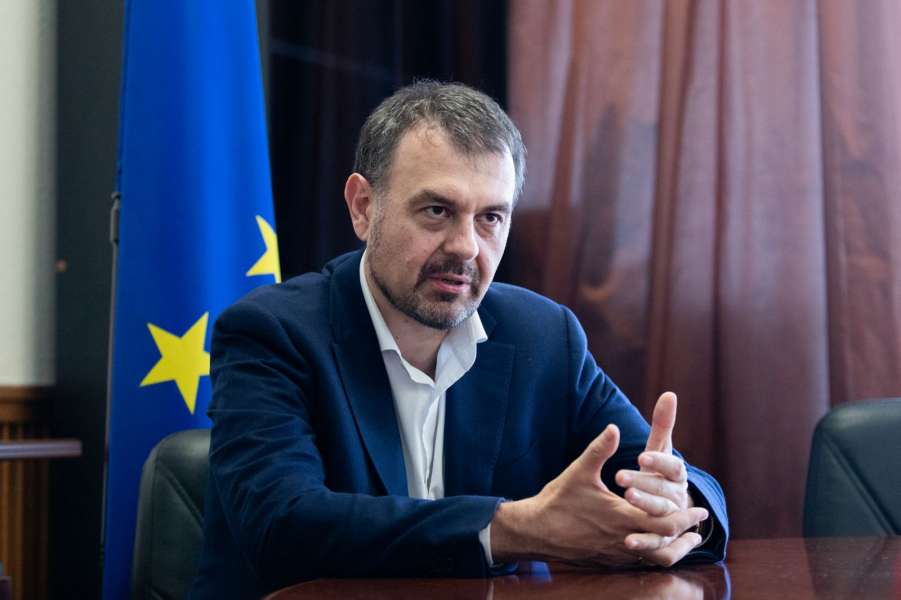
On June 9, the Verkhovna Rada adopted a law on the taxation of income generated through digital platforms. The legislation introduces international standards for the automatic exchange of information on income earned via marketplaces, taxi services, delivery apps, accommodation rentals, and similar sectors, creating conditions for the transparent taxation of such revenue. In an interview with the Press Service of the Apparatus of the Verkhovna Rada, Danylo Hetmantsev, Chair of the Committee on Finance, Tax, and Customs Policy, explained to what extent this law will simplify life for citizens and whether international platforms are ready to take on additional obligations in Ukraine.
— When can we expect this law to become fully operational?
— This is actually a very comprehensive law consisting of several core blocks: the international automatic exchange of information on income generated through digital platforms; the convenience and transparency for platform operators fulfilling their tax obligations in Ukraine; and the actual taxation of income earned by individual residents of Ukraine via these digital platforms.
Certain provisions of the law will come into force on November 1, specifically regarding the obligation for platform operators to register with the State Tax Service (STS). However, the majority of the legislative provisions will take effect on January 1, 2027.
— What is the most significant advantage of passing this law: the practical benefits of fulfilling international obligations, or the advantages of introducing modern rules for the digital economy?
— There is really no point in comparing this. This law is a win-win for everyone: the state, the businesses, and the users.
The state secures tax revenues for the budget. At the same time, for implementing reforms that we primarily need ourselves, Ukraine receives 90 billion euros from the European Union and over 8 billion dollars from the IMF. Therefore, in my view, there is nothing to debate here: we are passing a law that benefits us directly, while simultaneously securing vital support from our partners. For that, we can only be grateful.
I would certainly like to see more of these kinds of decisions and programs in the future.
— In your opinion, what is the more compelling argument in favor of this law for ordinary Ukrainians?
— This law addresses three core elements.
First, Ukraine is introducing an accessible administrative mechanism: the digital platform itself will withhold the tax from the individual and remit it directly to the state budget.
Second, it introduces an exemption for the sale of goods: you can sell items via these platforms up to a threshold of 2,000 euros completely tax-free.
Third, it establishes a lowered tax rate on income generated through digital platforms. Currently, the rate stands at 23% (Personal Income Tax plus the Military Tax). Once the law takes effect, a 10% Personal Income Tax rate will apply, along with an explicit exemption from the Military Tax.
— And moving forward, could the rate be adjusted proportionally to any reduction in the military tax rate?
— Yes. It is directly tied to the military tax. Our military tax operates at a rate of 5% for the duration of martial law and the subsequent three years. In the fourth year following the lifting of martial law, the tax will drop to 1.5%. The tax rate withheld from sellers by digital platforms will be adjusted accordingly.
This means that [three years after the war ends in Ukraine — Ed.], instead of 10%, the rate will drop to 6.5%, and eventually to 5% once the military tax is fully phased out.
— The preparation of this law took over a year. Which specific provisions were successfully refined prior to its final passage?
— Compared to the Ministry of Finance's draft, the bill was completely rewritten. All potential risks were fully eliminated even before it was considered in its first reading.
We rejected the provision regarding the mandatory disclosure of banking secrecy. The Ministry of Finance had proposed introducing specialized bank accounts to which the tax authorities could gain access. This provision has been entirely excluded from the law.
Furthermore, we introduced an exemption: sales up to a threshold of 2,000 euros are completely tax-free. In the initial government bill (No. 14025), which was rejected by the Verkhovna Rada in March, the exemption was capped at 12 living wages (approximately 36,000 hryvnias) and was conditional upon filing a tax return.
Additionally, we permitted Sole Proprietors (FOPs) to operate via digital platforms. Under the Ministry of Finance's original version, this was strictly prohibited.

— Many EU countries have already been operating under similar information-exchange rules with digital platforms for several years. What positive outcomes have they observed following the implementation of these mechanisms?
— Why do we call this an integration-focused law? Because we are implementing DAC7 into our national legislation - the EU directive that regulates the exchange of information between states regarding income generated through digital platforms.
This is a universal principle and a rule that operates across all EU member states: platforms transmit information to the state regarding the income earned by sellers from various countries utilizing the respective platform, and states then exchange this data among themselves through international automatic exchange frameworks.
Beyond the EU, the exact same mechanism operates in other countries that have joined the DPI (the Multilateral Competent Authority Agreement on Automatic Exchange of Information on Income Derived through Digital Platforms). As of today, this includes 35 nations, counting EU member states.
There may be slight variations across different countries. For instance, there are jurisdictions where digital platforms do not withhold the tax, and individuals must file a tax return and pay the tax independently. However, as a Committee, we rejected that specific setup, even though it was heavily debated during the drafting phase.
— Does this mean that under the new law, digital platform users will no longer have to file tax returns independently?
— They will not have to, provided that the individual operates through a registered platform. The provision mandating compulsory tax filing was struck from the bill even before it was introduced to the Verkhovna Rada. Up to half a million of our citizens earn income through these platforms.
This includes couriers, taxi drivers, and ordinary people who sell items using various digital services.
For such a massive number of people, a mandatory reporting requirement would be unduly burdensome. This law is specifically designed to simplify life for Ukrainians. The sole requirement is to operate via a registered platform. The registry of platform operators will be publicly available on the State Tax Service website. If an individual operates through an unregistered platform, standard tax regulations will apply. That said, the platforms themselves have a strong incentive to register, as registered operators gain a competitive advantage as fully compliant, legal businesses.
— Which categories of Ukrainians will be most impacted by the new rules: landlords, taxi drivers, freelancers, or online sellers?
— The general public will not experience any changes whatsoever. Ask yourself a simple question: how many goods did you sell through a digital platform last year?
Our statistical data is clear: over 95% of citizens sell less than 2,000 euros worth of goods over the course of a year. This means that ordinary citizens who do not engage in trading as a regular business will see no impact at all.
— Could you elaborate on the core obligations that will now be imposed on digital platforms?
Platforms are subject to four primary obligations. First and foremost, platform operators must register with the State Tax Service if sellers from Ukraine generate income through their platforms.
Second, platforms must strictly verify user identity. This means that individuals who conceal their identity or remain anonymous will no longer be able to use these services.
Third, e-commerce goods platforms will tax a user’s income exceeding 2,000 euros per year at a rate of 10% and remit these funds directly to the state budget.
Fourth, service platforms will tax all generated income starting from zero and similarly remit those funds to the budget. Additionally, platforms are required to transmit data regarding the seller's total earnings to the tax authorities.
Previously, every individual had to manually file a tax return, log into their electronic taxpayer account, and reconcile exactly how much money they had earned over the year. That is a cumbersome process, you see? Now, ordinary users will not even notice anything happening behind the scenes. This administrative burden has been entirely shifted to the platforms, which will handle everything seamlessly behind a single click.
— How exactly will this work in practice?
— For example, if a delivery service employs 100,000 couriers, every single one of them must be identified, their earnings tracked, and taxes withheld. The only question is ensuring that this entire process occurs automatically.
Therefore, we discussed with platform representatives that they will make a one-off investment in software development. Moving forward, operations will be just as seamless as before. Furthermore, international platforms that already report vendor income to other DPI-signatory countries have already configured all the necessary architecture and can now simply scale these processes to encompass sellers in Ukraine.
Fifty years ago, you would have needed to employ a virtual army of accountants to process all of this. Today, digitalization enables us to handle this entirely without human intervention. That is precisely why software development is required.
— Regarding the 2,000-euro threshold for income from the sale of goods: how exactly will this limit be monitored and enforced?
— Platform operators will submit reports once a year in electronic format. Ukrainian operators and operators from countries that have not joined the DPI will report directly to Ukraine. Non-resident operators will be able to utilize a specialized portal solution developed by the State Tax Service, which is already successfully operating for value-added tax (VAT) payers who provide digital services.
Platform operators from DPI-signatory countries (qualified operators) will report to the tax authorities in their own jurisdictions. Moving forward, Ukraine will exchange this data with the respective country within international automatic exchange frameworks.
This is precisely how we obtain data from each platform regarding the volume of an individual's accrued income. The State Tax Service then reconciles this data. If it detects that the threshold has been exceeded, it will assess a 10% tax rate on the surplus amount and notify the individual of their obligation to pay this 10%.
In other words, if an individual sells on 10 different platforms and earns an annual sales income of 1,000 euros on each, the Tax Service will aggregate the data and inform them that a 10% tax must be paid on the 8,000-euro surplus.
— Marketplaces, taxi companies, and delivery services are effectively becoming tax agents, mandated to transmit data regarding user earnings to the tax authorities. Is the business community actually prepared to take on this role?
— Absolutely. All international digital platforms operating in Ukraine also operate in other European countries, where they already comply with identical requirements. Consequently, they possess the necessary user-interaction experience, have turnkey technical solutions ready, and raised zero objections to the bill—on the contrary, they supported it from the outset. We are speaking about platforms with a dominant presence on the Ukrainian market, such as Bolt, Uber, Uklon, and Glovo.
Furthermore, the drafting of the bill was conducted with complete transparency within the Committee. Since all major international platforms maintain representative offices in Ukraine, we held regular working meetings with their teams.
Immediately prior to the final vote, a large-scale forum was convened involving all digital platforms. Representatives from these services unanimously backed the passage of the bill.
As a result, we successfully developed a streamlined and effective mechanism that - crucially - was fully pre-vetted and agreed upon by the market stakeholders.
— In fact, the EU introduced these regulations specifically to combat the shadow economy. Is there already concrete empirical evidence demonstrating the true effectiveness of this approach?
— The state of the fight against the shadow economy in European nations versus Ukraine represents two entirely different realities. In the EU, the shadow economy operates as a concealed, isolated anomaly. In our case, however, manifestations of the shadow economy are visibly pervasive across virtually every sector and industry.
Consequently, the implementation of this automatic information-exchange framework is genuinely the absolute linchpin of our strategy to curb the informal economy.
— Will it operate the exact same way in Ukraine? Can we confidently state that the enacted law will incentivize citizens to transition from gray-market earnings to formalized employment? And conversely, do you foresee a significant surge in the number of registered sole proprietorships across the country as a direct consequence?
— The law will absolutely incentivize the transition to formalized employment. However, it will not lead to an increase in the number of sole proprietorships. Our goal is to drive formalization without forcing people to register as corporate entities.
Previously, if a taxi driver or courier wanted to partner with a digital platform, they had to formally register as a sole proprietorship (ФОП) and immediately confront a laundry list of administrative and bureaucratic hurdles. In fact, certain platforms even mandated that their couriers register as individual entrepreneurs as a prerequisite for onboarding. This law will decisively remedy that situation.
Moving forward, there is a straightforward flat rate, with taxes remitted directly to the budget without any accompanying formalities. Consequently, this entire sector will completely emerge from the shadow economy, ensuring that taxes are seamlessly paid.
— Is there a risk that some individuals might attempt to offset this new tax burden by increasing the prices of their services?
— The pricing of services is entirely market-driven. If an operator is in a position to raise prices during periods of peak demand, they will do so.
For instance, when Kyiv experiences heavy snowfall or severe traffic congestion, ride-hailing fares, as the media frequently notes, 'skyrocket to the moon.' This phenomenon is dictated entirely by live market dynamics, completely independent of the tax framework.
— Can we anticipate that the implementation of this taxation framework will bolster Ukrainian citizens' trust in digital platforms, market transparency, and the state?
— Will this law foster greater systemic trust? I believe it absolutely will. It is an undeniable fact that this is an exceptional administrative mechanism—one that we would highly desire to scale across other sectors.
Furthermore, public trust will strengthen alongside improvements in our taxpayer-centric service standards. The Tax Service is continuously refining this area. Should any discrepancies arise, data can be quickly cross-referenced and rectified if an error is discovered. However, in reality, these digital platforms utilize incredibly sophisticated software infrastructure. I am entirely confident that errors will simply be non-existent.
— What is the primary myth or misconception surrounding this law that you would most like to definitively dispel?
— There was no shortage of myths surrounding this legislation. It is absolutely vital to clarify that this is not a 'tax on selling socks' law. The Verkhovna Rada did not convene to levy an entirely new tax on the buy-and-sell marketplace. On the contrary, the tax rate for the sale of goods and services has been slashed from 23% down to 10%.