Grant Funding for the Venice Biennale May Be Suspended if russian Participants Are Allowed — Committee on Humanitarian and Information Policy Supports the European Commission’s Decision
11 March 2026, 17:38
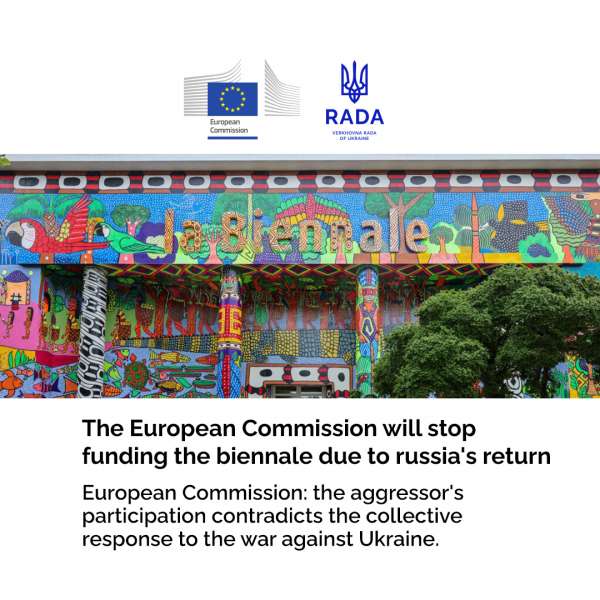
The European Commission informed about possible suspension or termination of grant funding for the Venice Biennale in case russia is allowed to open its national pavilion at the 61st International Art Exhibition 2026.
This was stated in a joint statement by Executive Vice-President of the European Commission Henna Virkkunen and European Commissioner for Intergenerational Fairness, Youth, Culture and Sport Glenn Micallef, published in Brussels on 10 March 2026.
It is emphasised that the European Commission strongly condemns the decision of the Venice Biennale Foundation to allow russia reopen the work of its national pavilion. Representatives of the European Commission highlighted that the EU position regarding russian's illegal and aggressive war against Ukraine remains unchanged, and that member states, institutions and cultural organisations must act in accordance with EU sanctions.
The European Commission noted that culture plays an important role in promoting democratic values, supporting open dialogue, diversity and freedom of expression. At the same time, culture should not be used as an instrument of propaganda or as a platform for those who support or justify kremlin's aggression against Ukraine.
According to Henna Virkkunen and Glenn Micallef, the decision of Biennale organizers is incompatible with the EU collective response to russian aggression. In case the Biennale Foundation does not reconsider its position and allow russian to participate, the European Commission will consider further steps, in particular the suspension or full termination of EU Grant for Biennale Foundation.
“The Committee supports the decision of the European Commission regarding the possible suspension of Venice Biennale grant funding if russian participants are allowed to take part, as well as supports a joint statement of the Ministry of Foreign Affairs of Ukraine and the Ministry of Culture about the situation around russian pavilion at Venice Biennale,” said the Deputy Chair of the Committee on Humanitarian and Information Policy Yevheniia Kravchuk.
According to her, there can be no “return to normality” while Russia’s full-scale war against Ukraine continues. The total number of civilians killed and injured in 2025 was 31% higher than in 2024 and 70% higher than in 2023, according to the United Nations Human Rights Monitoring Mission in Ukraine.
“Therefore, arguments that ‘culture is outside politics’ sound particularly cynical when they are used to mask aggression,” emphasised Yevheniia Kravchuk.
At the same time, the history of the russian pavilion in Venice Biennale demonstrates how important systematic support for culture is — not only from the state but also from businesses and private patrons. The construction of this pavilion in the early twentieth century became possible, in particular, thanks to a contribution from the Ukrainian patron of the arts Bohdan Khanenko, who in 1913 donated significant funds for its construction.
According to the Deputy Chair of the Committee, after the revolution the pavilion was expropriated by the Soviet Union and later effectively inherited by russia as its “successor state”, in the same way as numerous diplomatic buildings around the world.
“russia will invest resources in expanding its cultural presence around the world, will try to promote it wherever possible, and will use it for its own propaganda purposes. Today, supporting Ukrainian culture is a strategic issue. Culture is not only about art and heritage — it also shapes the world’s perception of Ukraine, its values, history and identity,” concluded Yevheniia Kravchuk.
It should be recalled that on 2 March 2026, russia’s representative for international cultural exchanges and former Minister of Culture of russia, Mikhail Shvydkoy, announced that the country plans to reopen its national pavilion at the Venice Biennale. russia has not participated in the event since 2022 following the start of its full-scale invasion of Ukraine.
On 4 March, the organisers of the Biennale published the list of national pavilions, which also included russia.
Information about russia’s possible participation has sparked criticism from the Ukrainian cultural community and international organisations, which consider such a decision unacceptable in the context of russia’s ongoing war against Ukraine. Ukrainian diplomats and cultural representatives have called on the organisers to reconsider the decision and maintain the position the Biennale had adhered to in previous years.