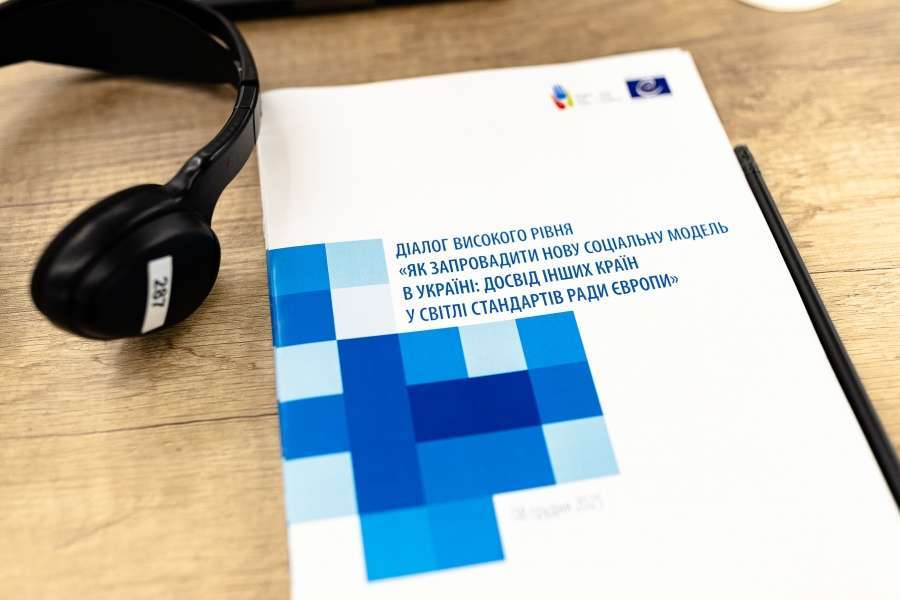
The Chair of the Committee on Social Policy and Protection of Veterans' Right, Halyna Tretiakova, took part in the event: High-Level Dialogue: «How to implement a new social model in Ukraine: the experience of other countries in light of the Council of Europe standards»
11 December 2025, 12:18
The event, which took place on 8 December 2025, was organised by the Council of Europe projects «Strengthening the Social Dimension in Ukraine» and «Supporting Ukraine in Implementing Council of Europe Standards on the Judiciary», which are being implemented as part of the Council of Europe Action Plan for Ukraine «Resilience, Recovery and Reconstruction» for 2023-2026, as well as the project «Supporting the Development of Constitutional Justice in Ukraine», which is being implemented within the framework of the joint programme of the European Union and the Council of Europe «Partnership for Good Governance», phase II.
The participants paid special attention to the issues of systematic analysis of social data, determining the actual level of its completeness, as well as the need to improve state mechanisms for collecting and processing information used to make social decisions. Separate discussions were held on the challenges facing Ukraine in the context of war and the need to strike a balance between citizens' expectations and the priorities of protecting the interests and security of the state and society as a whole.
During her speech, Halyna Tretiakova, Chair of the Verkhovna Rada Committee on Social Policy and Protection of Veterans' Rights, focused on the key principles, challenges and systemic conditions in which the state's social policy currently operates and its legislative reform is being implemented.
She outlined the main systemic parameters (‘tracks’) that determine the conditions for the formation of social legislation:
1. Speed of decision-making track
The first context is the extremely high speed of decision-making in the field of social policy throughout the entire public policy cycle:
- years of failure to update relevant legislation;
- the legacy of court decisions;
- the conditions of martial law and the COVID-19 pandemic.
At the same time, according to Halyna Tretiakova, the Committee ensures openness: up to 120 representatives of public organisations and social partners can attend the meetings.
2. Track of legitimate expectations during wartime
The second context is the concept of ‘legitimate expectations,’ which cannot be fully realised in wartime because, during martial law, the state has the right to make certain deviations from general standards.
She emphasised that such deviations are natural, but at the same time must be clearly recorded and justified.
It was also noted that the collective security of the state objectively prevails over individual expectations, which affects the balance when making decisions about social transformations.
3. The track of social redistribution justice
The third context is the increased public demand for fair distribution of resources.
The Chair of the Committee drew attention to:
- the significant gap between the minimum and maximum payments in the social security system;
- imbalance in the tax burden and the lack of an adequate taxation system, in particular the return of part of the personal income tax to the breadwinner.
She stressed that there is a structurally unfair redistribution in Ukraine, which society does not perceive as fair (equal).
The Chair of the Committee also outlined important areas for further work:
1. The need to ensure the financial capacity of the state when making any social decisions.
2. The transition from purely social payments to a combined model: social payments + social services + social infrastructure (in particular, social housing).
3. Strengthening social dialogue and improving consultation procedures between the state, employers, trade unions and the public.
4. Clarifying and delimiting the powers of the state and local self-government bodies, in particular the transfer of some functions from district state administrations/regional state administrations to communities.
Halyna Tretiakova also expressed her gratitude to the Council of Europe and international partners for their support, expert opinion and monitoring activities, which contribute to the development of high-quality decisions.
The high-level dialogue on ‘How to implement a new social model in Ukraine: the experience of other countries in light of Council of Europe standards’ provided a platform for professional discussion of key approaches to modernising social policy, harmonising national practices with European standards and forming a comprehensive vision for the transformation of the social protection system.