Representatives of the Committee on Ukraine's Integration into the EU took part in Forum 2000 in Prague
15 October 2025, 10:06
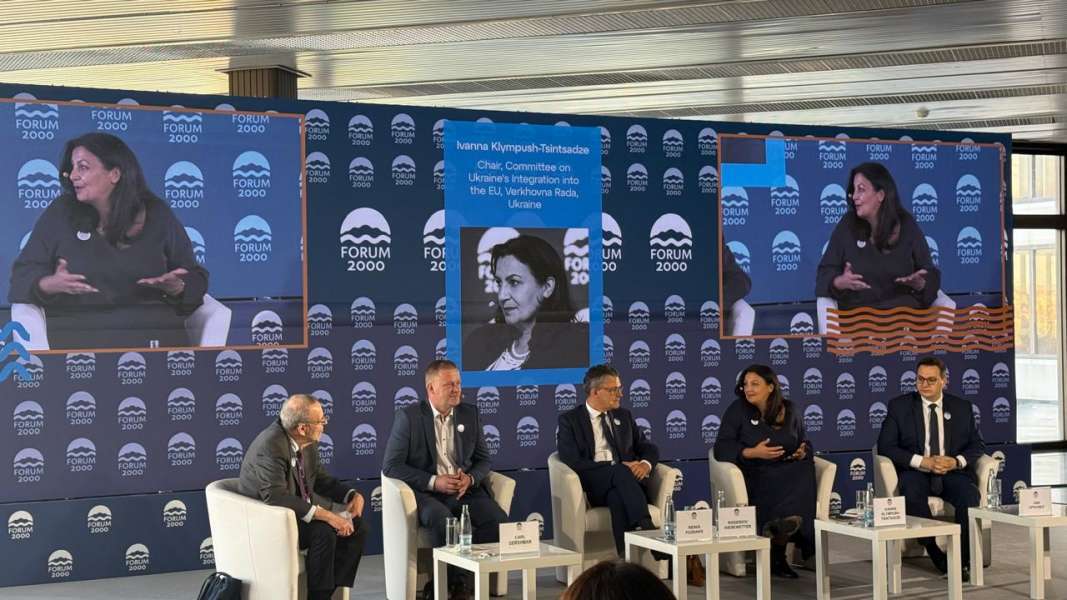
The Chair of the Committee on Ukraine's Integration into the EU, Ivanna Klympush-Tsintsadze, and the First Deputy Chair of the Committee, Vadym Halaychuk, took part in Forum 2000, which is held annually in Prague. Forum 2000 is an international platform that has been bringing together opinion leaders, diplomats, politicians and representatives of civil society for more than a quarter of a century to discuss the future of democracy and global security. This year, the event brought together more than 750 participants from over 100 countries. Experts from South America, Africa, and Asia, which, according to Ivanna Klympush-Tsintsadze and Vadym Halaychuk, made it possible to formulate the goals and threats facing Ukraine and Europe in a broader context, as well as to better understand the global priorities and challenges facing societies in other regions. «It is fundamentally important for us that the forum has a separate track, the so-called ’Ukrainian forum‘, which analyses in greater depth the processes related to our security challenges, defence needs, democratic transformation and European integration,» said Ivanna Klympush-Tsintsadze.
In addition to participating in the track dedicated to russia's war against Ukraine, the Chair of the Committee also spoke in the discussion "Ukraine: at the heart of Europe's future security architecture?", which discussed how Ukraine's role in European security should develop, what security guarantees are needed, and how NATO, the EU and regional partnerships should be rethought to include Ukraine as a key player in European defence.
Ivanna Klympush-Tsintsadze noted that Ukraine is currently the de facto main guarantor of security on Europe's eastern flank. It defends itself on the border between the democratic world and the authoritarian coalition. «On a global historical scale, we are talking about the model of statehood in general: whether the democratic achievements of the post-war era will be preserved or whether the world will return to authoritarianism in one way or another. Unfortunately for us, Ukraine is at the epicentre of this confrontation,» said the Committee Chair.
According to her, Ukraine is already a participant in the European defence system, which has not yet been fully established. This system is still in a state of transition from complete reliance on the American security umbrella to an awareness of continental responsibility for security in Europe. «Ukraine today is, in fact, the main performer of the security function for the EU and Europe as a whole,» Ivanna Klympush-Tsintsadze is convinced.
She added that what is happening in Europe today — drone incursions, the blocking of European airports, the detection of enemy aircraft in maritime zones, and even drone strikes on private homes in border areas — is only the beginning. «The purpose of these acts of sabotage is to test the European security system and look for red lines there. Unfortunately, these acts will inevitably be followed by aggressive attacks of one scale or another. Every time we fail to recognise this, it will cause huge problems in the future,» warned the chair of the Committee on Ukraine's Integration into the EU.
She insisted that long-term support for Ukraine in its struggle against russia is not charity or abstract humanism, but a component of European security for decades to come. Therefore, the question of Ukraine's status in the European security system, in NATO, and in global relations is already being raised today. «De facto, Ukraine is a frontline state at the forefront of European defence against a common enemy — a coalition of the world's last dictatorships. But what about de jure? There is still no answer to this question. Ukraine is not a member of NATO and does not belong to any other formal or informal associations or formats. In reality, it is a key element of security today, but this is not reflected in any regulatory or legal documents and therefore makes support for Ukraine dependent on the political will of European leaders,» said Ivanna Klympush-Tsintsadze.