Ukraine expands cooperation with Germany in the pharmaceutical sector and harmonisation of standards with the EU
10 October 2025, 11:52
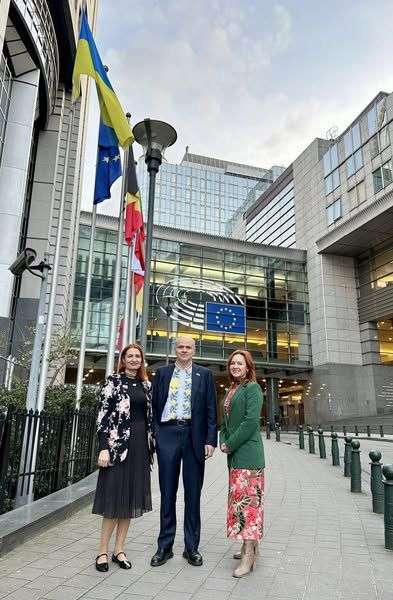
Taking Ukraine's interests into account when adopting the EU Critical Medicines Act, mutual recognition of GDP and GMP certificates, and a joint Twinning project to establish a Ukrainian pharmaceutical agency were the main topics of a joint meeting of the Ukrainian and German parliamentary committees.
These three important issues were discussed during a joint online meeting of the Verkhovna Rada Committee on National Health, Medical Care and Medical Insurance and the Bundestag Committee on Health. The Ukrainian side was led by Committee Chairman Mykhailo Radutskyi. The meeting was also attended by members of parliament who are members of the Committee and Deputy Minister of Health Maryna Slobodnichenko. The German delegation was represented by members of the Committee headed by Chair Tanya Machalet and State Secretary of the German Ministry of Health Tino Sorge.
Regular offline and online contacts between the committees have been ongoing since March 2023. During this time, the parties have already cooperated on expert consultations on European integration draft laws, the introduction of self-government in the field of health care, the regulation of the use of medicinal cannabis-based drugs, the development of pharmaceutical services, physical rehabilitation and mental health. This time, Ukrainian and German parliamentarians discussed issues related to the development of the pharmaceutical sector and its alignment with European Union standards.
In March this year, the European Commission presented a draft Regulation on critical medicines. The document aims to improve the availability, supply and production of critical medicines in EU countries, as well as to reduce Europe's dependence on the supply of active pharmaceutical ingredients from India and China. Mykhailo Radutskyi emphasised that Ukraine has a powerful pharmaceutical industry capable of supplying medicines not only to Ukrainian patients but also to European patients, even in wartime. Amendments have been submitted to the Critical Medicines Act that recognise Ukraine's strategic role in shaping the future architecture of EU pharmaceutical security. The Committee Chair asked his colleagues in the Bundestag to support these amendments through German representatives in the European Parliament. The German side acknowledged that during the COVID-19 pandemic, serious bottlenecks arose in the supply of medicines, so Germany passed a law requiring the purchase of some basic medicines exclusively from European manufacturers. This reduces dependence on Asian suppliers. The parties agreed to discuss in more detail how such purchases could be organised at the bilateral level and what role Ukraine could play in this process.
As Mykhailo Radutskyi noted, thanks to the Law on Medicinal Products adopted by the Committee, Ukrainian legislation in this area has already been brought into line with EU standards. The law will come into force on 1 January 2027. Currently, some Ukrainian pharmaceutical manufacturers already have internationally recognised GDP and GMP certificates, but in order to export medicines to EU countries, companies are required to undergo several inspections by European authorities. During the discussion, the parties raised the issue of mutual recognition of pharmaceutical quality standards at the government level and the possibility of extending the Agreement on Conformity Assessment and Acceptance of Industrial Goods (ACAA) to medicinal products. The so-called ‘pharmaceutical visa-free regime’ would open the way for simplified access for Ukrainian manufacturers to the EU market and, conversely, for European companies to the Ukrainian market.
According to the law on medicinal products, a state control body in the pharmaceutical sector, the Ukrainian Pharmaceutical Agency, is to start operating in Ukraine on 1 January 2027. The European Commission has already launched a Twinning project to create such a structure. It will be implemented by a consortium from Lithuania, Poland and Germany. The aim of the project is to create an organisation that will meet European standards of state control in the pharmaceutical sector. Three key areas of work are envisaged: the development of subordinate legislation, the establishment of the structure of the body, and the training of Ukrainian specialists.The German side expressed interest in expanding Twinning cooperation with Ukraine in other areas as well.
During the meeting, German MPs noted the rapid pace of harmonisation of Ukrainian legislation with EU standards and expressed admiration for the fact that Ukraine continues to implement systemic reforms even in the context of war. They are also interested in exchanging experience with the Ukrainian side on improving the resilience of the healthcare system to crisis situations. Mykhailo Radutskyi invited his colleagues from the Bundestag to visit Ukraine for further discussion of cooperation prospects.
‘I would like to thank the German people, parliament and government for their comprehensive support for Ukraine — financial, humanitarian and military assistance and fruitful cooperation in the medical field,’ the Committee Chair emphasised.