Screening of Ukraine's Transport Legislation for Compliance with European Union Law Conducted
01 July 2025, 14:15
From 24 to 27 May 2025, a bilateral meeting between Ukraine and the European Commission took place in Brussels (Kingdom of Belgium) as part of the official screening process assessing the compliance of Ukraine’s legislation with European Union law under negotiation chapters 14 “Transport” and 21 “Trans-European Networks.”
Over the course of four days, the Ukrainian delegation, consisting of representatives from executive government bodies and sectoral enterprises (including the Secretariat of the Cabinet of Ministers of Ukraine, Ministry for Communities, Territories and Infrastructure Development, Ministry of Internal Affairs, Ministry of Economy, Ministry of Health, State Transport Safety Service, State Aviation Service, Shipping Administration, Recovery Agency, National Police, National Bureau for Transport Investigation, SE “DerzhavtotransNDIproekt”, SE “Ukrainian Sea Ports Authority”, SE “Ukrvodshlyakh” inland waterways enterprise, and the Municipal “Maritime Search and Rescue Service”), as well as from the legislative branch (Members of Parliament of Ukraine – members of the Verkhovna Rada Committee on Transport and Infrastructure), presented the European side with structured information on the current level of alignment between national legislation and the European Union acquis across major transport sectors.
In addition, the Ukrainian side outlined its further plans to approximate Ukraine’s legislation to the provisions of European Union law (EU acquis) and to ensure compliance of legislative acts with Ukraine’s obligations in the field of European integration.
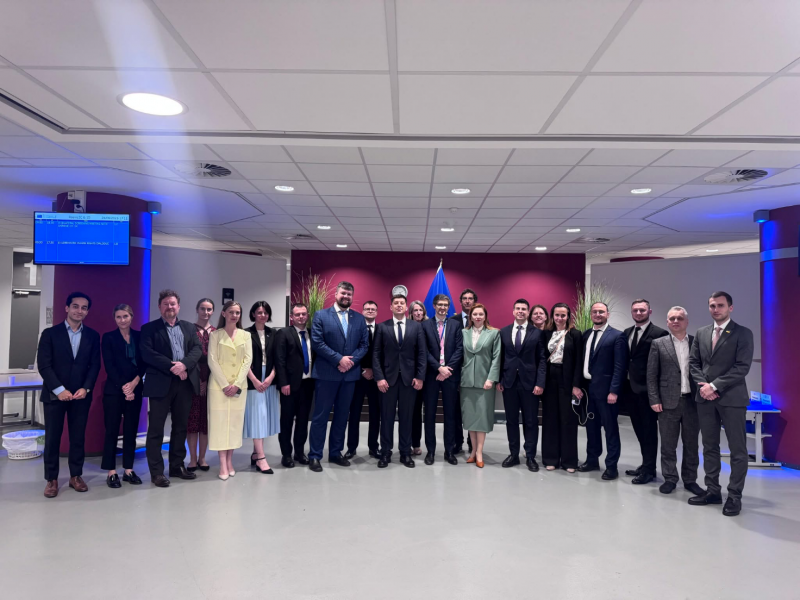
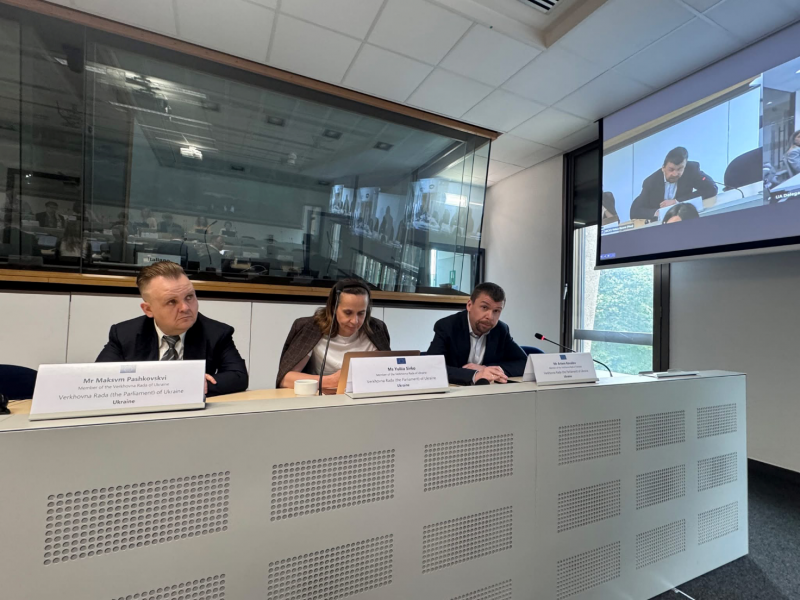
Participation in the screening process was conducted in a hybrid format (offline/online). In particular, the following members of the Verkhovna Rada Committee on Transport and Infrastructure took part in the meeting in person: First Deputy Chairman of the Committee Yuliia Sirko; Chairman of the Subcommittee on the Approximation of Ukrainian Legislation to European Union Law and Fulfilment of Ukraine’s International Legal Obligations in the Field of European Integration, Maksym Pashkovskyi; Chairman of the Subcommittee on Railway Transport and the Subcommittee on Inland Water Transport, Artem Kovaliov; and Chairman of the Subcommittee on Pipeline Transport, Kostiantyn Bondarev. Committee Chairman Yurii Kisiel joined the meeting online.
The first day was devoted to issues concerning road transport and road infrastructure, including road tolling, vehicle dimensions and weights, access to the profession of road transport operator, access to the market for freight and international passenger transport, tachographs, drivers’ driving times and rest periods, implementation of social legislation, posting of drivers, driver licensing and training, speed limitation devices, environmentally friendly and rented vehicles, alternative fuel infrastructure, intelligent transport systems, and other related topics.
The second day continued the discussion on road transport and road safety, including statistics and trends, roadworthiness of vehicles and roadside inspections, vehicle registration documents, distinguishing signs, tunnels, road infrastructure safety management, cross-border exchange of information. It also addressed the carriage of dangerous goods (by road, inland waterway, and rail) as well as a broad range of issues related to railway transport—namely, the Single European Railway Area, the European rail freight corridor network, train drivers’ licensing and social aspects, technical compatibility/interoperability, and railway safety. The agenda further included discussions on combined transport and Public Service Obligations (PSOs).
The third day focused on air transport issues, including market functioning, insurance requirements, airport slots, airport charges, ground handling, environmental protection and noise, the Single European Sky, air traffic management, aviation safety, and air security. Discussions also covered passenger rights across all modes of transport, the guiding principles of the Trans-European Transport Network (TEN-T), and the EU’s Connecting Europe Facility (CEF) programme.
On the final, fourth day, the discussions focused on maritime transport issues (market access for services, trade facilitation, seaports, passenger safety, state control of ports, vessel traffic monitoring, flag state and recognized organizations, seafarer training, pollution prevention, incident investigation, insurance and liability, technical safety requirements for vessels, maritime security) and inland waterway transport (market access, employment and skills, vessels, River Information Services), as well as corruption prevention in the transport sector.
Overall, within the transport sector, Ukraine needs to implement approximately 400 EU legal acts (regulations, directives, decisions, etc.) out of more than 3,000 that have already been analyzed. Some of these require adoption at the level of laws, while others will be implemented through acts of the Cabinet of Ministers of Ukraine and ministerial orders.
During the screening, the European Commission posed few questions to the Ukrainian delegation, with most European experts limiting their input to brief comments.
It should be noted that the screening is the first formal stage of the negotiation process regarding Ukraine’s accession to the European Union. Its purpose is to assess the level of alignment of Ukrainian legislation with the provisions of the EU acquis and to identify areas requiring changes to ensure compliance with European Union law (EU acquis).
The next step will be the preparation by the European Commission of a report summarizing the results of the official screening of Ukrainian legislation in the fields of transport and trans-European transport networks. This report will serve as the basis for the commencement of negotiations on individual chapters. The report is expected to be presented within six weeks.