Verkhovna Rada Committee on Legal Policy and Justice hosts roundtable entitled "Results of implementation of Law of Ukraine "On condemnation of communist and national-socialist (nazi) regimes and ban on propaganda of their symbols"
30 June 2016, 17:11
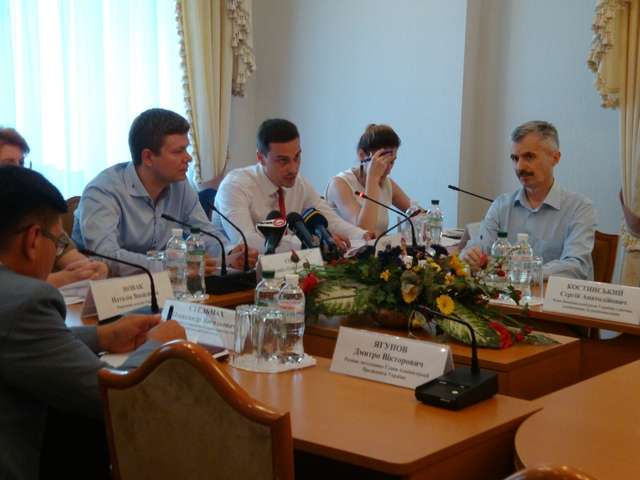
The participants in the event were people's deputies of Ukraine, representatives of bodies of state power, Ukrainian experts, non-government organizations, and associations.
First deputy chairperson of the Committee Leonid Yemets invited the participants in the event to discuss the procedure and consequences of implementation of the Law of Ukraine "On condemnation of communist and national-socialist (nazi) regimes and ban on propaganda of their symbols," conclusions of the European Commission for Democracy through Law (Venice Commission) and legislative initiatives.
Spokesperson of the Ministry of Justice of Ukraine Dmytro Kokhan informed about the activity of the Working commission on observance of the Law of Ukraine on decommunization. He said that over a year of its existence, the Commission took three decisions on non-conformity of naming of political parties, as well as the decision on non-conformity of symbols of the Socialist Party of Ukraine. He added that respective appeal is being drafted. He said that the Ministry of Justice is also drafting appeals on acknowledgement of respective certificates of a number of printed media organizations on their annulments in view of the failure of their founders to bring the names of their organizations in compliance with the Law of Ukraine.
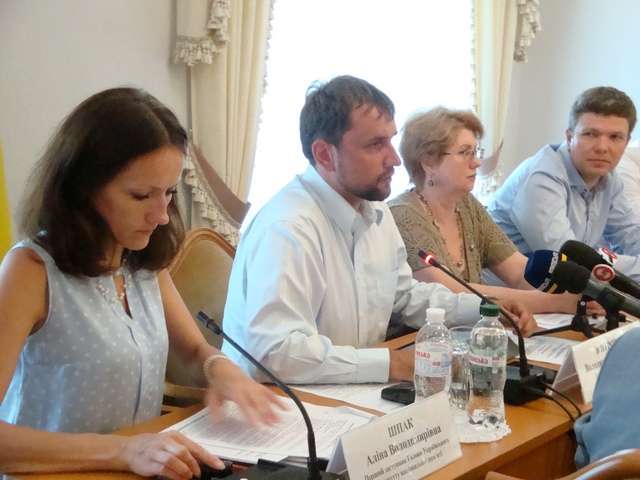
Head of the Ukrainian Institute of National Remembrance Volodymyr Viyatrovych noted that the law was aimed at providing certain legitimate borders for the process of decommunization in order to dismantle communist-time monuments in a civilized way.
Viyatrovych also noted that the wave of the monument dismantling took its start only in May 2016 however, no information about its results has yet been received. He stressed that unfortunately some local self-government bodies ignore the implementation of the said Law, which in its turn provokes unauthorized desire of the citizens to observe it.
The head of the Ukrainian Institute of National Remembrance also informed about the course of renaming the population centers, streets and other names in the regions of Ukraine. "As at June 30, with its nine resolutions, the Verkhovna Rada of Ukraine renamed 1,000 administrative units of the administrative-territorial status in Ukraine. A total of 13 such units including two regions are still to be renamed," he said.
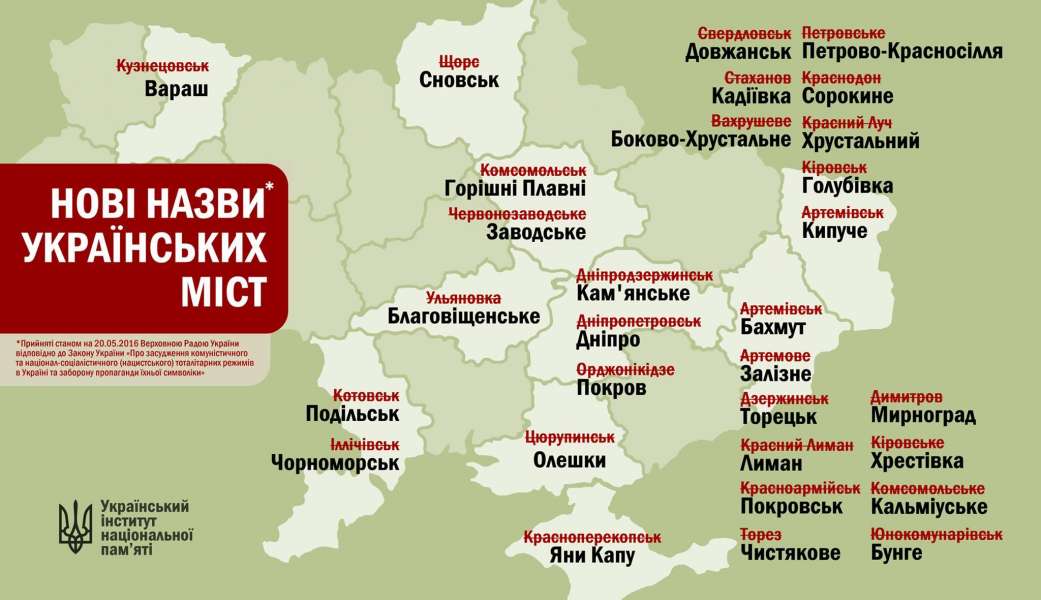
Viyatrovych noted that the major problems today are the absence of the single database or register of the to-be-renamed units, as well as the database of the monuments. He stressed that the general problem in the implementation of this Law is lack of respect to the legislative acts and the failure to understand the whole necessity for their fulfillment.
The head of the Institute informed about the draft law elaborated by the Ministry of Justice along with the public representatives on amendments to the Law of Ukraine "On condemnation of communist and national-socialist (nazi) regimes and ban on propaganda of their symbols." It was elaborated to fulfill conclusions and remarks of the Venice Commission to the Law.
Viyatrovych noted that the draft law is likely to be backed by the majority of the deputies and called on the Committee members to consider it as soon as possible.
Leonid Yemets said that the Venice Commission concluded that the Law follows legal goals however, some of its notions need certain technical upgrade. He called the adoption of this draft law a top-priority for the Ukrainian Parliament.
Vice-president of the Association of People's Deputies Oleksandr Barabash drew attention of the roundtable participants to the fact that the Law should not divide the timeline into periods "as it was done regarding the 1990s." He suggested that the people's deputies exclude the term on division into the periods or replace it with the timeline corresponding to historic reality.
Chairperson of the subcommittee of the Verkhovna Rada Committee on Legal Policy and Justice Nataliya called the Law very important for Ukraine's independence.
The people's deputy noted that the Venice Commission provided a number of remarks to the Law inter alia stating whether it is possible to condemn the regime instead of its specific figures.
She said that most of the Ukrainian people support the process of population centers' renaming in compliance with the Law.