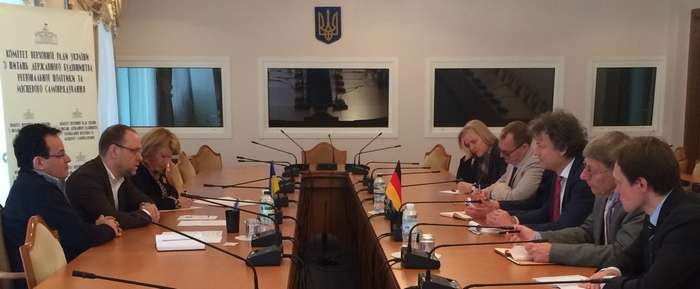
Verkhovna Rada Committee for State Building, Regional Policy and Local Governing hosts meeting between Committee Head Serhii Vlasenko, Committee Member Oleh Bereziuk and representatives of number of missions and projects of German Federal Enterprise for International Cooperation (GIZ)
16 April 2015, 16:14
The participants of the meeting were: Jochen Gauly — head of the Integrated Urban Development mission; Stefan Draeger —head of Decentralization In Ukraine mission; Iris Gleichmann — coordinator of the GIZ project in Lviv; Timo Bianc — an expert of GIZ project; Mariyana Kukhlevska — an expert of GIZ project; Taras Zhuravel — coordinator of the GIZ project called Management Reform In East Of Ukraine.
Jochen Gauly informed about the task of the mission he heads. He said that the mission during three years would realize integrated development programs in three Ukrainian cities: Chernivtsi, Vinnytsia and Poltava. According to him, the essence of the integrated approach is systematic and complexity measures, as opposed to purely sector-based or sector planning approaches. The program of similar nature is already underway in Lviv, where it already showed positive results. Elaborating the program in three new cities, representatives of the missions took into account the need for involvement of communities from the west, center and the east of Ukraine, where the administrations, business and the public are almost prepped for respective cooperation. At later stages, results obtained in these cities could serve as a good reference point for distribution at the level of respective regions and the state as a whole.
Serhii Vlasenko thanked representatives of GIZ for “attention to Ukraine, honest striving to see Ukraine a civilized, European and a democratic country.” The Head of the Committee said that such a result can be achieved thanks to reformation of power via the decentralization, however, Ukraine still requires more efforts to pave itself a way to successful decentralization. He also noted that the Committee considers that the basic level of reformation is village, town and city communities. The Committee also calls important the raising of their ability to take requisite measures and provide services. Therefore, the Integrated Urban Development mission appears to be quite timely and useful.
Characterizing the presented measures of the mission, Bereziuk called them a program of breaking of stereotypes and traditional approaches. He said horizons of cooperation are being expanded; and that the cooperation between the villages, towns and cities is being deepened. The most considerable problem and important financial aspect is the attraction of funds from the European Union as well as local and state budgets.
Stefan Draeger drew attention of the Committee to necessity for collection of comprehensive information about those, who will receive respective assistance. At that the priority will be the strengthening of communities as the major subjects of decentralization of power. He also raised the question of the role of oblasts in the decentralization, taking in account specifics of oblasts, necessity for elaboration and application of wide range of instruments for citizens as to their participation in the processes of the decentralization.
According to Serhii Vlasenko, only some legal steps have been taken in the field of decentralization, in particular, respective Law was adopted; however, its practical implementation has not yet been launched. The Head of the Committee noted that it is just a part of the problem. “Comprehensive decentralization of power cannot be held without amending the Constitution of Ukraine. There is no a single unified concept of perfection of constitutional provisions today. There were some ideas and steps of the President of Ukraine. Respective parliamentary commission headed by the chairperson of the Verkhovna Rada has been established. However, the process is too slow and we absolutely failing to be on time with it. Especially taking in account planned holding of regular local election on October 25,” Vlasenko said.
Bereziuk pointed to possible disagreements in the course of decentralization among bodies of local self-government and local state administrations, local and central levels of authorities. He explains that with the administration of financial resources. He also pointed out the importance of experience of the Eastern Europe in reformation of local self-government and decentralization of power, necessity for unity of branches of authorities and the society during determination of conceptual grounds for the decentralization. He noted that such a goal has not been achieved so far.
The Head of the Committee thanked the guests for constructive negotiation, expressed readiness for cooperation, provision of any possible assistance and assured that the Committee is ready to be a communicative platform with explanatory, enlightenment and propaganda functions.