"The population of Ukraine must receive water that meets established safety and quality requirements": Chairman of the Committee on Environmental Policy and Nature Management Oleh Bondarenko on the new water quality control system and European standards
20 October 2026, 14:31
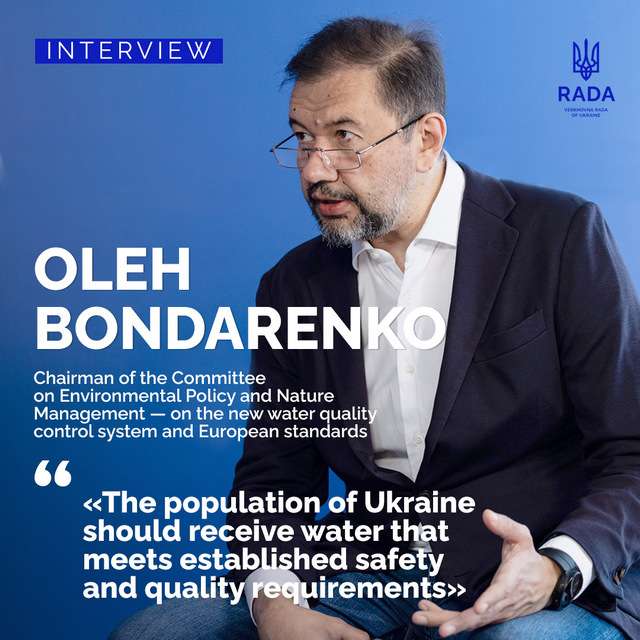
Law No. 4978-IX recently entered into force, forming part of the European integration reforms in the field of drinking water supply and sanitation.
In an interview with the Press Service of the Secretariat of the Verkhovna Rada, Chairman of the Committee on Environmental Policy and Nature Management Oleh Bondarenko discussed the new water quality control system and the systemic problem it is designed to address.
— Law No.4978-IX is a part of the European integration reforms in the field of the drinking water supply and drainage. What is its fundamental novelty, and what kind of systematic problem is it designed to address?
— This law is not the first step in aligning Ukrainian legislation on water supply and sanitation with European standards. In recent years, we have been consistently working in this direction. To be frank, this process has accelerated precisely during the full-scale invasion. We have already adopted legislative amendments concerning the specifics of wastewater discharge, as well as an updated version of the law on water supply.
The current law represents the next stage in implementing European standards. Its primary innovation is an environmental approach to ensuring drinking water quality and the introduction of a risk-based quality management system. The ultimate goal is to ensure that the population of Ukraine receives water that meets established safety and quality requirements. This is also one of our European integration commitments.
— Instead of responding to already detected pollution, the law provides for a risk-oriented approach – meaning that potential risks for the quality of water must be identified in advance? How will this approach work in practice?
A risk-based approach differs from current practice in that it enables us not only to respond to problems, damage or poor water quality that have already been identified, but also to identify potential threats in advance. At present, we rely primarily on the results of monitoring and testing the water supplied to the public. In contrast, the risk-based approach involves a comprehensive control system — from the water source to the consumer. This is a significantly more complex mechanism, which makes it possible to prevent problems and create a unified, higher-quality system that is, without exaggeration, of a European standard. We know that in many European cities, water is safe to drink straight from the tap. This is the result of a comprehensive approach to water quality. At the same time, treatment alone does not solve all the problems: it is important to monitor water quality throughout its entire journey. It is necessary to identify risks at every stage, determine who is responsible for addressing them, and oblige water utilities and other participants in the water supply system to carry out continuous monitoring. If a threat is identified, it must be eliminated or a programme of appropriate measures drawn up. The results must then be monitored. It is precisely this end-to-end system that enables a systematic approach to water quality, rather than merely reacting to individual problems.
— The law allows for temporary derogations from certain drinking water quality requirements. Under what circumstances is this possible, and does such a derogation mean that the water may be unsafe for consumption?
First and foremost, this is not a Ukrainian innovation, but an approach set out in the relevant European directive, the provisions of which we are implementing. The possibility of a temporary derogation is provided for in clearly defined cases. For example, when it is impossible to ensure that water in a specific region or settlement meets the established requirements during a particular period. Another scenario is a man-made disaster that could damage the existing water supply system or impair water quality. In such cases, a temporary derogation from certain requirements may be permitted. However, this does not mean that the water is automatically reclassified as industrial-grade or generally unfit for consumption. It refers to the possibility of applying different, temporary parameters or requirements in cases provided for by law. It is important to note that such derogations should not be interpreted as a waiver of drinking water safety requirements.
— If a person is facing a problem with water quality or regular disruptions to the water supply or drainage, which authority should they contact?
First and foremost, responsibility for the provision of services lies with the businesses that supply water and provide sewerage services. These may be state-owned, private or municipal enterprises; in most towns, this refers specifically to municipal water and sewerage companies. A contract is drawn up between the water utility and the consumer, setting out the terms and conditions of service provision. Therefore, the first step should be to contact the relevant utility to request that any shortcomings be rectified and that the appropriate quality of service be ensured. At the same time, the activities of water utilities are subject to oversight by the relevant local authorities and state regulatory bodies — within the limits of their powers. At the national level, this is handled, in particular, by the National Commission for Energy and Public Utilities Regulation. It licences the activities of water utilities, approves tariffs and monitors their operations in accordance with the powers set out in the relevant legislation. This enables the monitoring of the utilities’ activities and helps to ensure the provision of high-quality public services to the population.
— How will the law change the rules for connecting to centralised water supply and sanitation systems? What is provided for non-centralised systems, including septic tanks and local wastewater treatment facilities?
Connection to the centralised sanitation system will take place in accordance with the capacity of the water utility — the organisation providing water supply — and the conditions under which it can ensure connection. Where non-centralised sanitation or water supply is concerned, this is a private activity. The most important thing we have done in the field of water supply and sanitation is establishing the prerequisites for conducting such activities, particularly in the private sector, and setting certain requirements. Of course, the primary requirements will further be set out in subordinate legislation and regulatory acts of the Cabinet of Ministers of Ukraine. Generally, until now, this activity was not systematised. Through new provisions and legislation, we have systematised it and enabled its operation in full compliance with the law.
— How will the new legislation regulate situations where, as a result of russian attacks, industrial accidents, or infrastructure damage, water becomes unfit for consumption or its supply is interrupted?
Emergency response mechanisms were already provided for prior to the adoption of this law. They belong to a separate regulatory area covering emergency response in the fields of water supply, sanitation, electricity supply, and the provision of other public utility services.
Unfortunately, under war conditions, such situations have become highly pressing due to russian drone attacks, missile strikes, and hostilities. Therefore, this law does not establish a separate emergency response algorithm. Its objective is different: to define the requirements for water quality and services that must be provided, particularly after the consequences of accidents, destruction, or enemy attacks have been eliminated.
Naturally, following infrastructure damage, it is necessary to restore water supply and ensure the proper quality of services. However, this requires the application of other mechanisms provided for by emergency management legislation.
— Could the implementation of the European standards of water quality influence tariffs for centralized water supply and sanitation for population and business?
Indeed, there is a direct link between the quality of public utility services, the required investments, and their cost. This applies not only to water supply and sanitation, but also to other sectors, particularly waste management. This is also one of the areas falling within the remit of the Committee on Environmental Policy and Nature Management. All these areas require significant investment, modernisation, and infrastructure development.
When it comes to wastewater management, the state of the relevant infrastructure in Ukraine requires substantial improvement. Modernisation calls for combined funding sources: state and local budget allocations, investments from municipal utilities, and assistance from international partners. New water quality requirements may entail additional expenditure, particularly for the upgrade of treatment plants, water abstraction, transmission, and supply systems. After all, quality must be ensured throughout the entire journey — from the water body to the consumer’s tap.
It is essential to work not only with treatment facilities but also with water sources, including rivers and other water bodies. The quality of water entering the system must also meet appropriate standards. The law itself, as it stands, does not set specific tariffs. However, implementing its requirements will necessitate funding, meaning that the balance between the cost of services and necessary investment will remain a pressing issue.
— What specific changes are provided for regarding the interaction between water utilities, local authorities, and NEURC? Who will set the tariffs once the law enters into force?
The system of interaction between the NEURC (National Energy and Utilities Regulatory Commission) and water utilities has not changed, and this was one of the prerequisites for passing the law. Prior to its adoption, we held a series of consultations and roundtables involving the NEURC, water utilities, and community associations. Based on the results of these discussions, we defined how the system should operate. Municipal enterprises and local self-government bodies will receive the opportunity to set tariffs. At the same time, the tariff methodology, approval mechanisms, and monitoring of compliance with the relevant methodology will remain under the purview of the NEURC.
We moved as far away as possible from an approach where the state directly determines the cost of a particular service, and strengthened the role of local authorities. However, this also implies responsibility for complying with the requirements of the law and ensuring the proper quality of services. This approach was supported by representatives of local authorities, industry enterprises, and the NEURC. Ultimately, the law received support in the Verkhovna Rada during the second reading as well. In our view, this system should ensure the proper provision of services.
However, this requires other prerequisites as well. First and foremost—the end of the war, as the expected results could be neutralized by enemy strikes on water supply and sanitation facilities. The second important factor is the significant financial resources required to modernize infrastructure. We count on coordinated actions between state and local authorities, as well as assistance from the European Union and other international partners. The entire housing and communal services system requires substantial investment. This applies not only to water supply, but also to wastewater treatment—meaning sanitation—and waste management. We will be able to implement the necessary changes with the support of the EU and other partner countries. Similar assistance was received by other countries joining the European Union: grants, concessional loans, and financing for modernizing infrastructure and implementing European standards. After all, the quality of life and public services is what our citizens expect, and it is one of the prerequisites for the further development of Ukraine's economy.